
Key takeaways
The QR codes worth copying match the scan to the job in front of the person: a part on a production line, an item on a store shelf, a grocery order, a payment or a loyalty account. For printed marketing codes, use a stable URL on a domain you control and manage its destination separately; keep payment codes out of that workflow. Give each placement its own identifier, decide what visitors see when a product or offer ends, and measure the outcome, not just the scan.
A QR code scan isn't a purchase, and the gap can be substantial. Capri Sun's QR-enabled sweepstakes drew more than 579,000 landing-page views and more than 28,000 subscription entries, according to a Flowcode case study reported by the U.S. Chamber of Commerce[1]. Getting someone to open a page is only the beginning.
The printed code matters less than where it points. Brands get lasting value when they treat the printed square as a stable entry point and manage the destination separately. That means keeping product information useful, payment flows trustworthy, and expired promotions from becoming dead ends.
The QR code brands worth copying offer different lessons across manufacturing, retail, payments, and loyalty. Their mechanics aren't interchangeable. A payment code inside a wallet ecosystem works differently from a catalogue code that opens a public website, while collecting emails through guest WiFi[2] requires a different consent and access flow again.
The practical question isn't which campaign looked most inventive. It's what your team must maintain after launch. The examples below distinguish the brand's approach from recommendations you can implement, without inventing campaign budgets or assuming every brand used an editable redirect.
1. DENSO WAVE and the Origin of the QR Code#
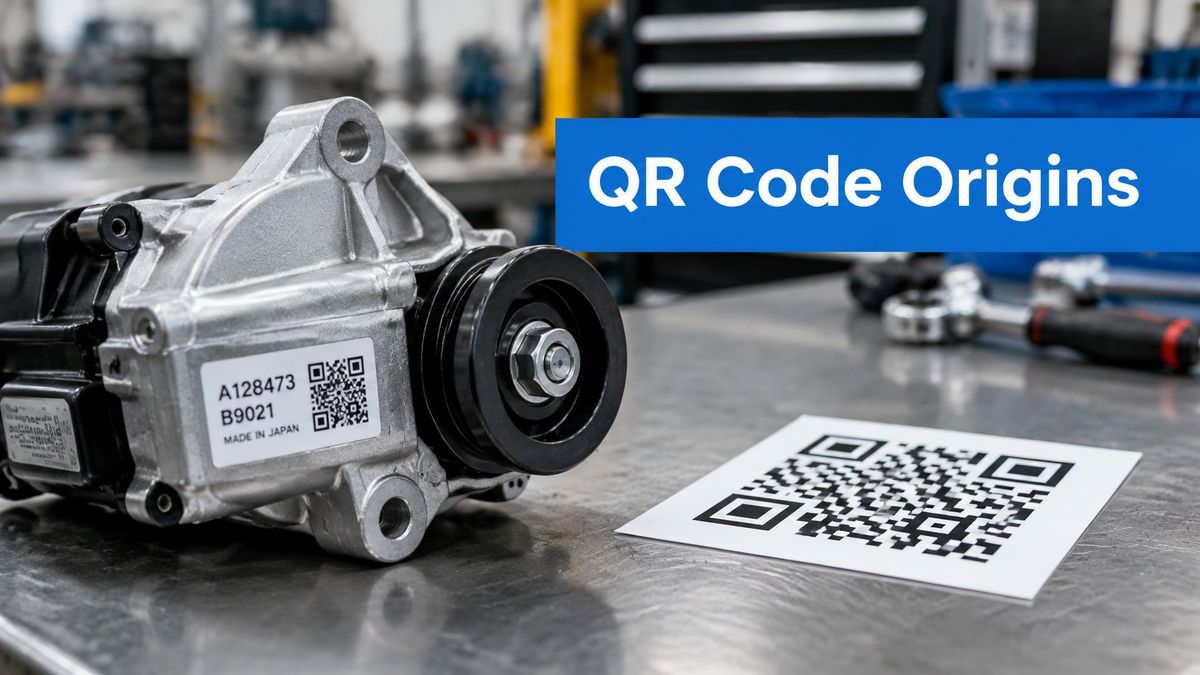
QR codes started with a factory problem, not a marketing brief. Masahiro Hara, an engineer at DENSO WAVE (then part of DENSO CORPORATION), developed the code in Japan, where it was announced in 1994; its first job was managing the production of automotive parts. It became the international standard ISO/IEC 18004 in 2000, according to DENSO WAVE's history of the QR Code[3].
That manufacturing context explains the original priority: a code small enough to print on parts that could still be read at high speed, even when partly soiled with oil. The transferable lesson isn't to imitate an automotive label. It's to make the scan resolve to the exact information someone needs while performing a task.
Copy the separation between identification and information#
For marketing teams, a product identifier can remain stable while its supporting content changes. Say an appliance maker prints a code beside a model number. Buyers should still reach the correct manual after the company replaces its website or reorganizes its support library.
The QR standard itself doesn't make a destination editable. A static code contains fixed information. An editable experience requires a stable URL whose redirect or underlying page your team controls.
That adds operational costs: domain administration, routing, content maintenance, and testing. It can spare a reprint when a destination changes, but it also creates infrastructure someone must own.
- Preserve readability. Keep strong contrast and a clear blank margin around the symbol.
- Test the finished asset. Scan the production-size label on its actual material, including curved or reflective surfaces.
- Assign an owner. Record who maintains the public URL and who approves destination changes.
Apply this quarter: Choose a long-lived product label, point it to a short URL on your domain, and test changing the destination without replacing the printed code.
2. IKEA and QR Codes on In-Store Price Tags and Signage#
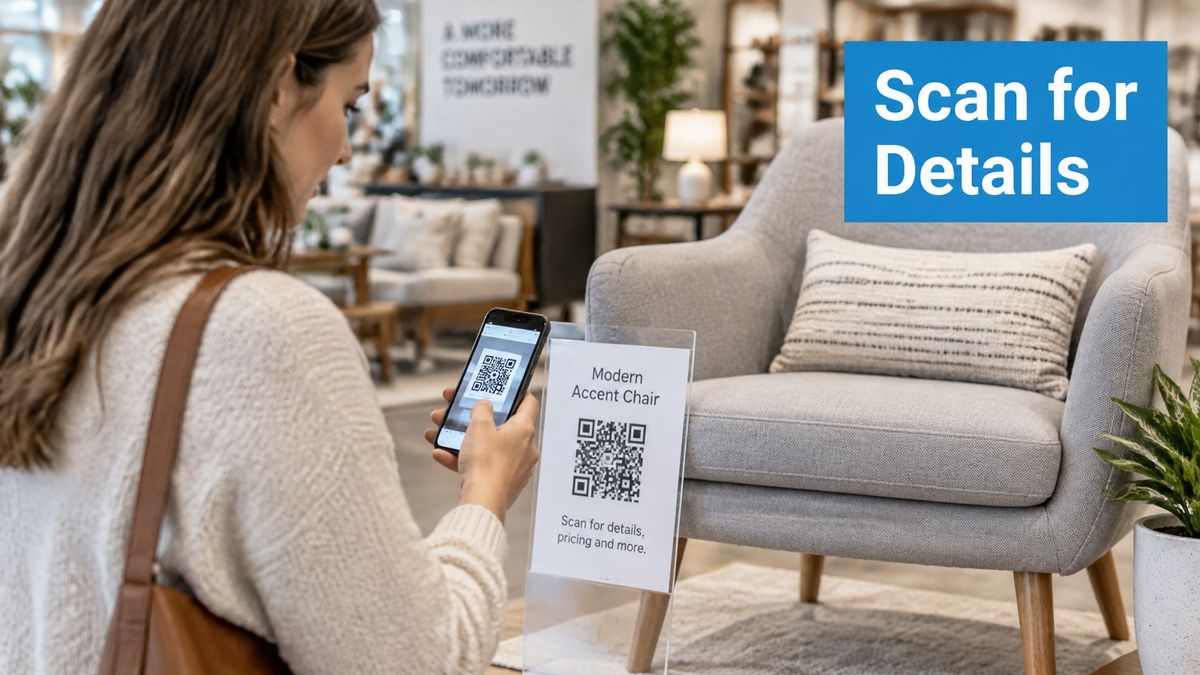
A shopper standing beside a chair doesn't need your homepage. They need the chair's dimensions, available finishes, stock information, or assembly guidance. IKEA's in-store codes show that the destination should match the object beside the code: in its UK stores, where available, a QR code below the price tag adds that item to the shopper's list in the IKEA app, and codes displayed around the store switch the app into scan mode, according to IKEA UK's Scan and pack as you shop page[4].
The useful mechanic is contextual access. A code on a tag or a sign opens the item it sits beside, without asking shoppers to retype a product name in search.
Keep product relevance after the print run#
The maintenance problem begins when a product changes. A printed brochure can remain in someone's home after a finish disappears, while a showroom sign can outlast the landing page it originally referenced.
For your own QR code campaigns, keep placement identity separate from product content. A showroom sign and a mailed brochure can use different tracked entry URLs while resolving to the same product resource.
If the item is discontinued, preserve the context. Explain its status, retain useful instructions, and offer a relevant replacement rather than redirecting everyone to a category page.
Hy-Clor provides a documented parallel for product-level education: its packaging program connected customers to learning resources and generated more than 180,000 scans across over 300 QR codes, according to Scanova's case study[5]. That supports the utility of product-specific help, not a claim about IKEA's results.
The cost to plan for is the content operation. Someone must maintain product mappings, handle discontinued ranges, and distinguish informational visits from purchase intent.
For example, a furniture retailer could send a shelf-sign scan directly to dimensions and availability, while a packaging scan opens assembly instructions. The product is the same; the customer's task isn't.
Apply this quarter: Replace a generic store QR destination with a product-specific page, give each placement its own identifier, and define what visitors see when the product is retired.
3. Homeplus and the Virtual Subway Store in Seoul#
Homeplus's virtual subway store turned grocery displays into a shopping interface. In August 2011, Tesco Homeplus put displays of more than 500 popular products on the pillars and screen doors of Seoul's Seonreung subway station; commuters scanned the QR code beneath an item with the Homeplus app and had it delivered to their home, according to Tesco's announcement[6].
The copyable mechanic is product-level entry into a transaction. The poster mattered because it presented recognizable groceries, but the commerce experience depended on what happened after the scan.
A scan-to-shop campaign needs more than an attractive mobile page. The retailer must support product availability, cart continuity, delivery eligibility, and checkout. The campaign format alone doesn't establish that those services will work in your market.
Route around inventory changes without losing intent#
Say a grocery brand places a breakfast-products poster in an office lobby. Each code should open the corresponding item or a tightly scoped selection, not an undifferentiated store homepage.
If an item becomes unavailable, the destination should explain that and offer an appropriate substitute. A silent redirect to an unrelated bestseller may preserve traffic, but it doesn't preserve the shopper's intent.
- Keep location attribution. Give each poster placement a distinct campaign identifier.
- Retain the basket. Test whether the cart survives sign-in, app switching, and checkout.
- Show fulfillment limits early. Let shoppers check delivery eligibility before they invest time selecting products.
The meaningful costs sit behind the poster: product-feed maintenance, commerce integration, creative production, placement, and fulfillment. Without a documented budget, assigning a campaign price would be misleading.
Nor should scans stand in for revenue. Track product-page arrival, add-to-cart, checkout, and completed order separately, then examine where people stop. A busy station may generate curiosity without producing profitable orders.
Apply this quarter: Pilot a shoppable display with a manageable product range and a defined fulfillment area. Keep the printed URLs stable, and test the unavailable-product route before publishing the artwork.
4. Alipay and QR Code Payments#
A payment QR code isn't a marketing redirect. Alipay illustrates why that distinction matters: the scan belongs to a payment workflow, whether the customer scans a code the merchant presents or presents a code for staff to scan, the two in-store modes Alipay+ describes[7].
The mechanic can simplify the physical acceptance point, but the printed sign is only the visible component. Merchant onboarding, wallet compatibility, settlement, refunds, and staff procedures still determine whether the transaction works.
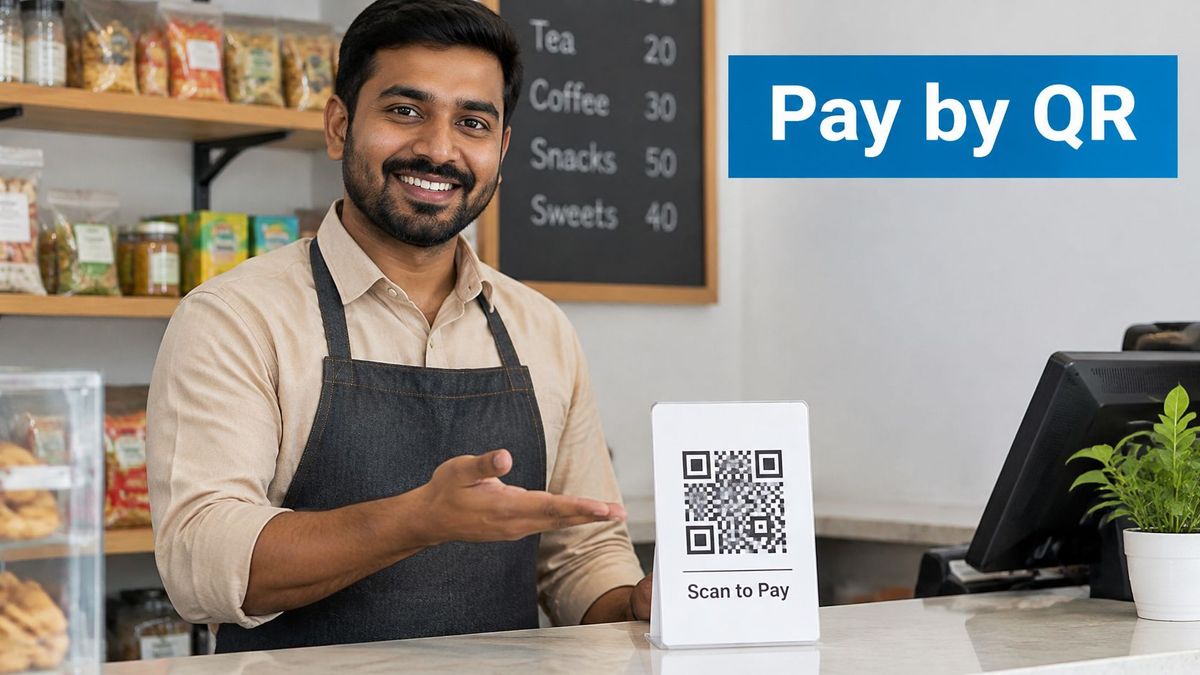
For a retailer considering enabling wallet payments at your counter[8], the decision starts with customer demand and merchant eligibility. It shouldn't start with the assumption that every visitor has the same wallet.
Protect the payment route from marketing changes#
Marketing teams should use a separate code for offers, newsletter registration, or product information. Don't place payment destinations under a general campaign-editing workflow.
Physical inspection matters too. Staff should know where approved payment codes appear, how to recognize an unauthorized replacement, and how to verify the merchant identity shown during payment.
The Federal Trade Commission's warning about QR codes on unexpected packages[9] explains that a QR destination can be designed to steal passwords or payment information. It isn't evidence about Alipay specifically, but it establishes why a familiar-looking square isn't proof of authenticity.
Your QR code security procedures should therefore cover both digital ownership and physical tampering. A branded logo helps recognition; it doesn't authenticate the destination.
For example, a café can display its approved payment code at the register and place a separate loyalty code on receipts. Staff can troubleshoot payment without accidentally sending customers into a promotional journey.
Apply this quarter: Separate payment and marketing assets, assign staff responsibility for checking counter displays, and document the escalation route for a suspicious code or incorrect merchant destination.
5. WeChat Pay and Tencent's QR Code Ecosystem#
WeChat demonstrates a different operating model: the destination can be a service inside an app rather than a public webpage. The WeChat Pay Open Platform[10] lists both counter modes, Quick Pay (the merchant scans the code a shopper shows) and Native Payment (the shopper scans a code the merchant generates), alongside payment inside a merchant's Mini Program.
For brands, that can connect discovery to an ongoing service that lives inside the app rather than on the open web.
The trade-off is ecosystem dependence. A journey that feels straightforward to an established WeChat user can be confusing or unavailable to someone outside the app.
Match the promise to the destination#
Use a call to action that names the task. Scan to order and follow for offers describe different outcomes and should not send customers through an indistinguishable flow.
A practical restaurant scenario is a table code that opens the relevant ordering experience. The team must keep menu availability, table context, and opening status accurate; the printed code can't compensate for an outdated service.
- Separate campaign sources. Distinguish packaging, table signage, and event materials in your reporting.
- Plan for unsupported users. Offer a readable web address or another route when the app-specific experience isn't available.
- Test the actual scanner. Check behavior inside the intended app as well as through a phone's camera.
Don't assume a generic browser redirect can reproduce every app-native interaction. Context-sensitive routing needs explicit implementation, testing, and a fallback that doesn't promise unavailable functionality.
The costs to evaluate include account administration, mini-program development where needed, localization, and service maintenance. Those commitments matter more than the effort required to generate the QR image.
Apply this quarter: Map an app-based journey from scan to completed action, document what happens outside the supported app, and give each physical placement a measurable source identifier.
6. Starbucks and QR Codes for Payments and Loyalty#
Starbucks offers a useful counterpoint to printed campaign codes. Its app connects an in-store transaction to a loyalty account, although the displayed code format varies by market: in the U.S., members earn Stars in store by scanning their member barcode in the app, according to the Starbucks Rewards Terms of Use[11], while in the United Arab Emirates the membership code is displayed as a QR code in the app[12].
Don't assume every Starbucks checkout symbol is a QR code. The operational lesson is broader: a scanned credential can connect a purchase, an account, and a reward when the checkout and loyalty systems support that relationship.
A store poster inviting someone to join a program performs a different job from the customer's payment or membership credential. The first is an acquisition route; the second belongs to account and transaction infrastructure.
Measure the reward, not just the scan#
For a comparable retail program, use a printed code to explain the offer and start enrollment. Then measure account creation, qualifying purchases, and reward redemption separately.
A QR code generator with tracking can help distinguish acquisition placements. It can't, by itself, prove that a scanner made a purchase or authorize access to a customer's loyalty record.
That boundary matters for privacy too. Scanning a poster doesn't establish consent to identify someone or send them marketing messages.
- Make eligibility visible. Explain who qualifies, which purchases count, and how customers receive the reward.
- Connect systems deliberately. Pass campaign context into enrollment where supported, then reconcile it with permitted transaction reporting.
- Prepare the expired-offer page. Keep the original promise visible enough to explain why it no longer applies.
The cost isn't just a discount. Your team must account for reward funding, point-of-sale integration, enrollment support, fraud controls, and staff training. A scan-heavy promotion can still fail if customers can't redeem it reliably.
Say a café promotes a first-purchase reward from a window sign. The useful outcome is an eligible customer completing and redeeming the offer, not merely opening the enrollment screen.
Apply this quarter: Select a loyalty offer, separate scan and redemption reporting, and prepare a clear post-expiry destination before printing promotional materials.
How the six QR code brands compare by setting, scan action, and practical lesson#
| Brand | Setting | Scan action | Practice to copy |
|---|---|---|---|
| DENSO WAVE: the origin of the QR Code | Automotive parts production; later used in consumer marketing | Scan to read encoded URLs, text, or other data | Use a dynamic code, maintain contrast and a blank margin, and test at final print size |
| IKEA: QR codes on in-store price tags and signage | Store price tags and in-store signs | Add an item to the shopping list in the IKEA app, or switch the app to scan mode | Place codes beside relevant products, use a clear call to action, and track scans by placement |
| Homeplus virtual subway store (Seoul, 2011) | Product displays in Seoul's Seonreung subway station | Scan an item's QR code in the Homeplus app to order it for home delivery | Use specific product links, track each location separately, and use a trusted branded domain |
| Alipay: QR code payments | In-store checkout at the counter | Scan a merchant's code or present a personal code to pay | Keep payment codes visible and well lit, protect them from tampering, and separate marketing codes |
| WeChat Pay: Tencent's QR code ecosystem | Counter payments and services inside Mini Programs | Show a payment code, scan a merchant's code, or pay inside a Mini Program | Use a clear call to action, separate campaign codes, and provide a working web fallback |
| Starbucks: codes for payments and loyalty | In-store checkout, loyalty, and mobile ordering | Present an in-app code to pay or earn rewards | Pair codes with clear incentives and measure sign-ups or redemptions by location |
Turning These QR Code Brands Into Your Playbook#
The common thread is operational, not visual. These QR code brands connect a recognizable entry point to a useful next action, but they don't all use the same infrastructure. Printed web links, wallet payment codes, and account credentials need different owners and controls.
For printed marketing assets, the strongest default is a stable URL on a domain your organization controls. Manage its destination separately so website changes, discontinued products, or expired offers don't force you to abandon the public address.
What the redirect adds to each scan#
A managed destination puts one redirect between the scan and the page, so its speed is part of the experience. Measured over the seven days to 3 November 2026 from Washington, D.C., Frankfurt and Tokyo, the median time to first byte of each provider's redirects was:
| Provider | Median time to first byte |
|---|---|
| RedirHub | 15 ms |
| Short.io | 55 ms |
| TinyURL | 93 ms |
| Bitly | 115 ms |
| Rebrandly | 267 ms |
These figures come from the RedirHub redirect speed benchmark[13], which measured 27 providers over that window (fastest: Amazon CloudFront, at 9 ms) and publishes its data under CC BY 4.0. Whichever service you use, check that each printed code reaches its page in a single hop.
Agree on ownership before approving artwork#
Marketing should define the promise and conversion event. IT or DevOps should establish domain, HTTPS, access, and routing responsibilities. Agencies should document the client's ownership and handover arrangements rather than leave critical campaign destinations attached to an individual employee's account.
Keep a register of the asset, placement, destination, content owner, and retirement plan. Record destination changes so another team member can explain why a code now opens a different page.
Measurement needs the same discipline. Raw scans, visits, form submissions, purchases, and redemptions aren't interchangeable. Decide which event demonstrates value before choosing what to display in the campaign report.
For example, smoother contact handoffs at conferences[14] require an accessible contact destination and an appropriate follow-up process. Counting scans alone won't tell you whether anyone saved the details or agreed to further communication.
Treat launch as the start of maintenance#
Test the final print size, material, lighting, and destination on representative phones. Include unsuccessful paths: an unavailable product, an unsupported app, an expired offer, or a visitor who declines optional data collection.
Review performance by placement after launch, then investigate weak outcomes rather than replacing the creative. A working scan followed by an abandoned form calls for a different fix from a code nobody can read.
Start with an asset you can maintain properly. Give it an owned-domain URL, a named destination owner, a meaningful conversion event, and a retirement route. That's a more useful foundation than distributing codes broadly before anyone owns what happens next.
RedirHub provides dynamic QR codes on your own domain, with editable destinations and scan analytics, so printed assets can stay in use when campaigns change. Create a branded entry point for your next print run and manage its destination alongside your other links and redirects.
Keep every printed code pointing somewhere useful
Create dynamic QR codes on your own domain, change where each one points after printing, and see which placement gets scanned.
Create a dynamic QR codeSources
- [1]QR Codes Drive Customer Engagement and Sales for Brands From Kraft Heinz to Marriott (CO— by U.S. Chamber of Commerce)
- [2]QR codes vs WiFi login for collecting customer emails (Purple)
- [3]QR Code 30th anniversary (DENSO WAVE)
- [4]Scan and pack as you shop (IKEA UK)
- [5]How Hy-Clor Used QR Codes for Customer Education (Scanova)
- [6]Tesco opens world's first virtual store (Tesco PLC, 25 August 2011)
- [7]Alipay+ in-store payment (Alipay+)
- [8]Becoming an Alipay Merchant in Singapore: A Practical Guide (Sambapay)
- [9]Scam alert: QR code on an unexpected package (Federal Trade Commission)
- [10]WeChat Pay Open Platform (WeChat Pay)
- [11]Starbucks Rewards Terms of Use (Starbucks, U.S.)
- [12]Starbucks Rewards Terms of Use (Starbucks, United Arab Emirates)
- [13]RedirHub redirect speed benchmark, 2026-10-27 to 2026-11-03
- [14]Digital Business Cards QR Code: The Complete 2026 Guide (SigFinch)
Frequently asked questions
Examples include DENSO WAVE, which created the QR Code to manage automotive parts production, IKEA's in-store price-tag codes, Tesco Homeplus's 2011 virtual subway store in Seoul, Alipay and WeChat Pay at the checkout counter, and Starbucks Rewards membership codes. Each solves a different job, so copy the mechanic that matches your own setting rather than the format.
Masahiro Hara, an engineer at DENSO WAVE (then part of DENSO CORPORATION), developed the QR Code in Japan, where it was announced in 1994 to manage the production of automotive parts. It became the international standard ISO/IEC 18004 in 2000.
No. A payment code belongs to a wallet's payment workflow, while a marketing code usually opens a web page whose destination your team edits. Keep them separate so a campaign change never touches the payment route, and so staff can check that the code on the counter is the approved one.
Point the code at a stable URL on a domain you control and change the destination behind it, rather than encoding the final page in the code. When a product is retired or an offer expires, send visitors to a page that explains what changed and offers a relevant alternative, not to the homepage.
A scan only shows that someone opened the link. Decide which later event proves value, such as an enrollment, a purchase or a redeemed reward, and track it separately for each placement. Capri Sun's sweepstakes, for example, drew more than 579,000 landing-page views and more than 28,000 entries.

Leo Astarothman is the Brand & Content Lead at RedirHub, where he shapes the company's visual identity, educational content, product experiences, and marketing strategies. He also specializes in system design. Simplifying complex redirect infrastructure into practical resources, product experiences, and campaigns that help businesses understand and adopt modern redirect management.
Related Articles
View All Articles