



301 Redirects for SEO Website Migrations
Free plan includes 100 URL redirects for small to medium migrations. Upload your URL mappings, point your DNS, and preserve rankings. Bulk 301 redirects, automated validation, and live monitoring—without server setup or code changes.
Set Up Migration Redirects in Minutes, Not Hours#
Manual URL mapping across server configs invites errors and delays launch. RedirHub centralizes migration redirects—from bulk import to DNS deployment to live monitoring.
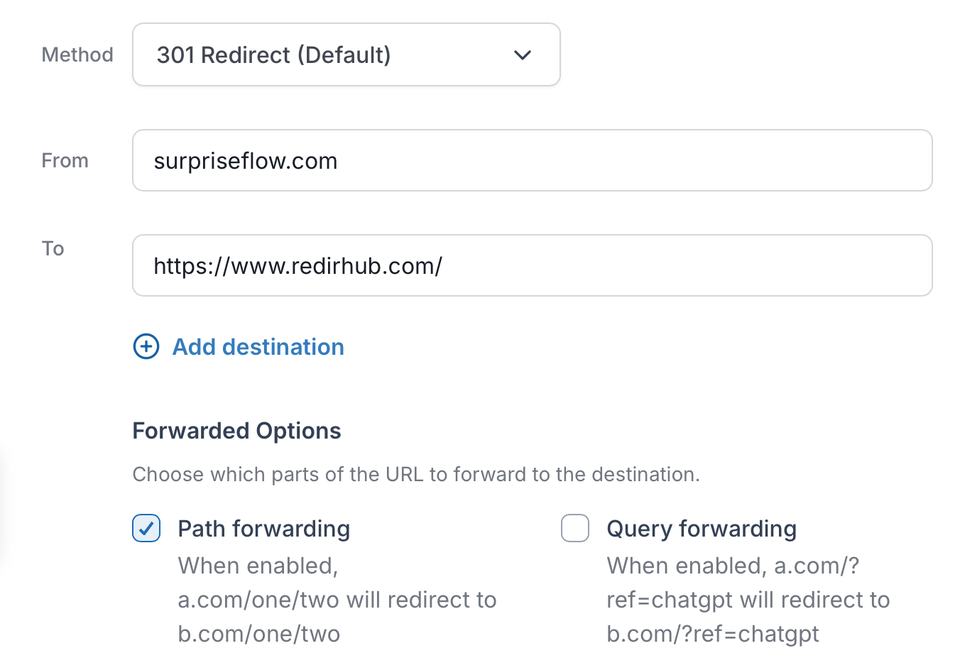
- Upload CSV or create domain redirects import hundreds of URL mappings at once, or point entire domains with automatic path matching—full control over every redirect.
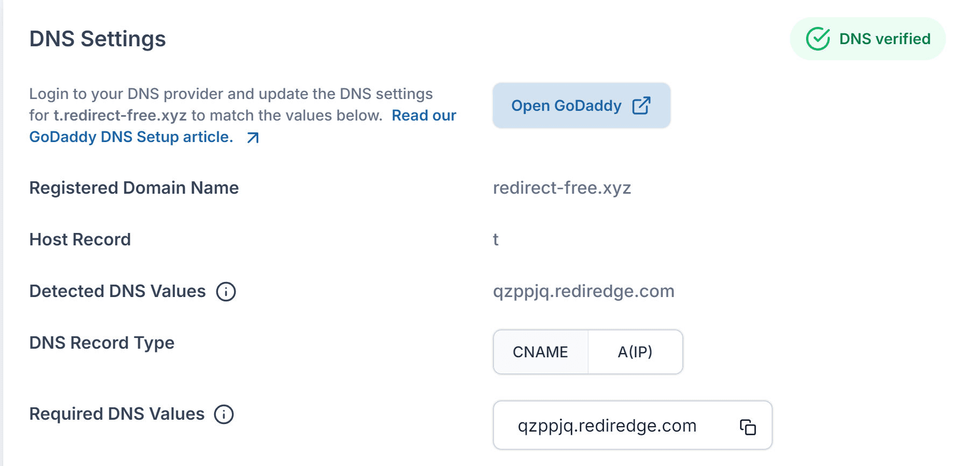
- Deploy with a CNAME record add one DNS entry and redirects go live globally in seconds—no server access, no deployments, no waiting for propagation.
- Validate and monitor continuously catch broken destinations before publishing, track redirect health after launch, and fix errors before search engines recrawl.
Start Free, Upgrade When You Grow#
| Capability | Free$0 | Basic$10/month | Pro$30/month | EnterpriseCustom pricing |
|---|---|---|---|---|
| Mapping URLs | 100 | 1,000 | Unlimited | Unlimited |
| Max Domains | 2 | 15 | 15 | Unlimited |
| Monthly Requests | 100k | 1 million | Unlimited | Unlimited |
| 301 Permanent Redirects | ||||
| Path Matching | ||||
| Query String Matching | ||||
| Bulk CSV Import | ||||
| Analytics | Basic | Detailed | Detailed | |
| Wildcard Redirects | ||||
| Priority Support | ||||
| Team Management | ||||
| Monitoring | ||||
| Custom SLA |
- No credit card
- Free SSL included
- Ready in 5 minutes
All plans include automatic HTTPS, instant global deployment, and path/query matching.
14-day free trial available on paid plans. No credit card required to start.
Map Hundreds of Pages in One Upload#
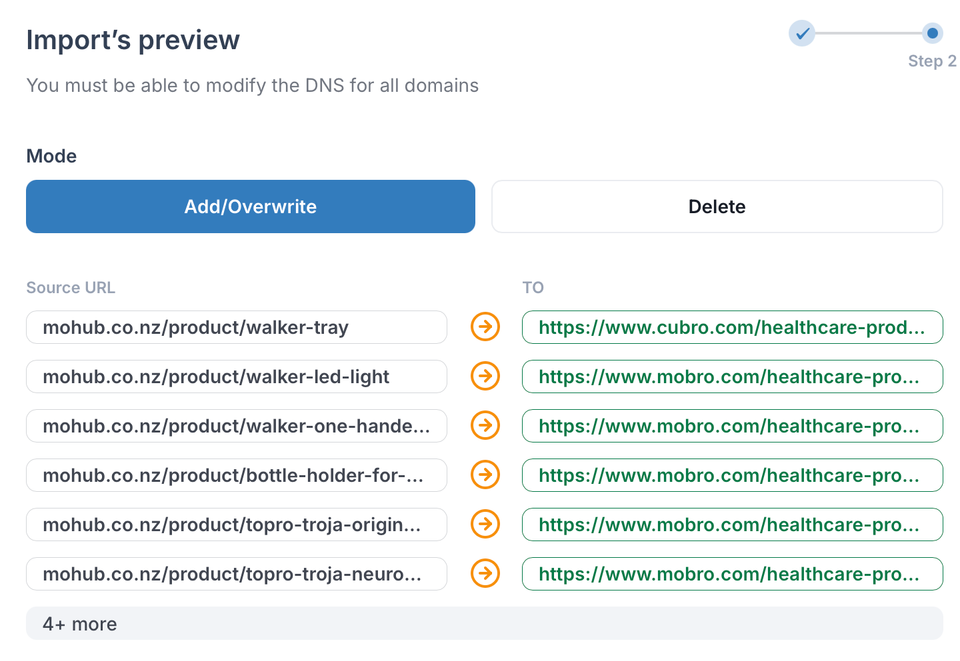
Manual URL mapping for large migrations invites errors. CSV import handles the heavy lifting — every source URL mapped to its correct destination at once.
- Bulk CSV import upload your full URL mapping — source, destination, and redirect type — in a single file.
- Preview before publishing review every redirect before it goes live and catch mapping errors before users or search engines hit them.
- Page-to-page precision map specific source URLs to exact destinations with full control over path and query string handling.
Go Live With Confidence, Not Fingers Crossed#
Before flipping the switch, validate that every redirect is correctly configured. Catch broken mappings before search engines and users do.
- Validation on import broken or malformed destination URLs are flagged during upload — before they go live.
- Instant activation when you're ready, redirects propagate globally in seconds — not hours.
- Disable instantly turn off individual redirects immediately if something isn't right post-launch — no server access needed.
Monitor Post-Launch — Before Rankings Drop#
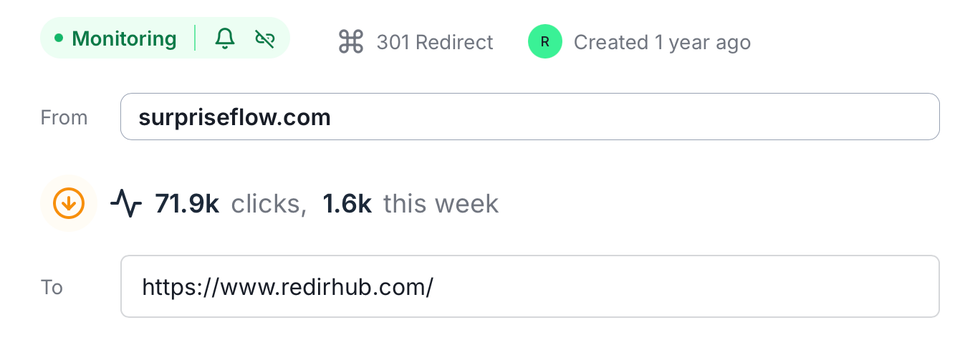
Traffic loss after a migration often doesn't show up in Search Console until days later. Destination monitoring gives you visibility the moment something breaks.
- Destination health checks automated checks alert you when a redirect destination goes down or returns an error.
- Error visibility see which redirects are generating errors directly in your dashboard — act before Google recrawls.
- Always-on monitoring continuous checks keep your migration redirects healthy long after launch day.
Website Migration Redirect Strategy to Preserve Rankings#
Website migrations - whether involving a domain change, CMS transition, HTTPS upgrade, or large-scale URL restructuring - introduce significant SEO risk if redirect strategy is not properly planned. When legacy URLs return 404 errors or are redirected incorrectly, search engines interpret the content as removed rather than relocated, resulting in lost link equity, crawl inefficiencies, and ranking volatility.
A structured website migration redirect strategy ensures that every old URL is permanently mapped to its most relevant new destination using clean 301 redirects. This preserves backlink authority, maintains crawl continuity, and signals to search engines that content has moved - not disappeared. Instead of relying on fragile server rules or manual configuration files, centralized redirect management provides controlled deployment, validation, and long-term stability throughout the migration lifecycle.
Bulk 301 Redirect Deployment with Validated URL Mapping#
Large website migrations often involve hundreds or thousands of URLs. Manually configuring migration redirects increases the likelihood of mapping errors, redirect chains, broken deep links, and indexing gaps. Bulk 301 redirect deployment allows SEO teams to manage complete URL mappings in a single, structured workflow.
Core website migration redirect capabilities include:
- Bulk CSV import for mapping legacy URLs to exact new destinations
- Pre-publish validation to detect broken, malformed, or unreachable URLs
- Permanent 301 redirect configuration to preserve ranking signals and link equity
- Full path and query string handling to maintain deep links and campaign parameters
- Instant global propagation of redirect rules without DNS changes or server redeployments
By deploying validated bulk redirects within a centralized migration environment, SEO teams reduce post-launch risk and prevent traffic loss before it occurs. Every URL change becomes measurable, auditable, and aligned with long-term organic performance - ensuring that website migrations protect rankings rather than disrupt them.
Pre-Launch Redirect Validation Before Website Migration Goes Live#
Even a well-prepared URL mapping can fail if redirects are not validated before launch. Broken destinations, redirect chains, incorrect status codes, or misaligned page mappings can silently weaken SEO performance from day one. Pre-launch validation ensures that every migration redirect is technically correct before search engines begin recrawling the updated structure.
Effective migration validation should include:
- Automatic detection of malformed or unreachable destination URLs during import
- Identification of redirect chains that dilute link equity and slow crawling
- Verification that all rules use permanent 301 status codes where required
- Confirmation that path and query strings are preserved correctly
- Controlled preview environment to review redirect mappings before activation
By validating migration redirects before go-live, SEO teams reduce ranking volatility and avoid reactive fixes after traffic drops. Redirect testing becomes a preventive safeguard rather than a post-launch emergency response.
Post-Migration Redirect Monitoring to Protect Traffic and Rankings#
SEO risk does not end at launch. After a website migration, search engines continue crawling legacy URLs for weeks or months, and external backlinks may point to deep pages long after the transition. If a redirect destination breaks, returns an error, or is modified incorrectly, traffic loss can occur before it appears in Search Console or analytics reports.
Continuous post-migration redirect monitoring provides visibility into redirect health, error generation, and destination availability in real time. Automated health checks detect when a redirect target returns 4xx or 5xx errors, while centralized dashboards highlight problematic mappings that require correction. This proactive oversight protects crawl integrity, preserves link equity, and stabilizes organic performance throughout the reindexing period.
Plan, validate, and monitor your website migration redirects within a centralized platform - and preserve rankings, traffic, and backlink authority through every structural change.
Why Our Customers Love RedirHub

Very useful website for redirects and creating short URLs. Highly recommend RedirHub.

Our project has been using their 301 redirect service for six months, and it has remained consistently stable.
bgz Wh
Frequently asked questions