The Slowest URL Redirects, Ranked: Is Yours on the List?

Key findings
We timed how long 12 real redirect links from 11 services take to answer, from the US, Europe and Japan. The slowest took 388 ms on average and 823 ms from Tokyo; the fastest took 17 ms. Two lessons stand out: where your visitors are matters as much as which service you use, and one link never tells you how fast a whole service is. You can test your own link for free at the end of this post.
823 ms before the first byte arrived. That was the median for the Cuttly link we tested from Tokyo, compared with 129 ms from Frankfurt and 212 ms from Washington DC. Nobody sees that number, but every visitor waits for it before the real page even starts loading.
So we measured. Using our free redirect speed test, we timed 12 redirect links across 11 services on October 16, 2026. Below is the ranking, then each link one by one, from slowest to fastest, and what it all means at the end.
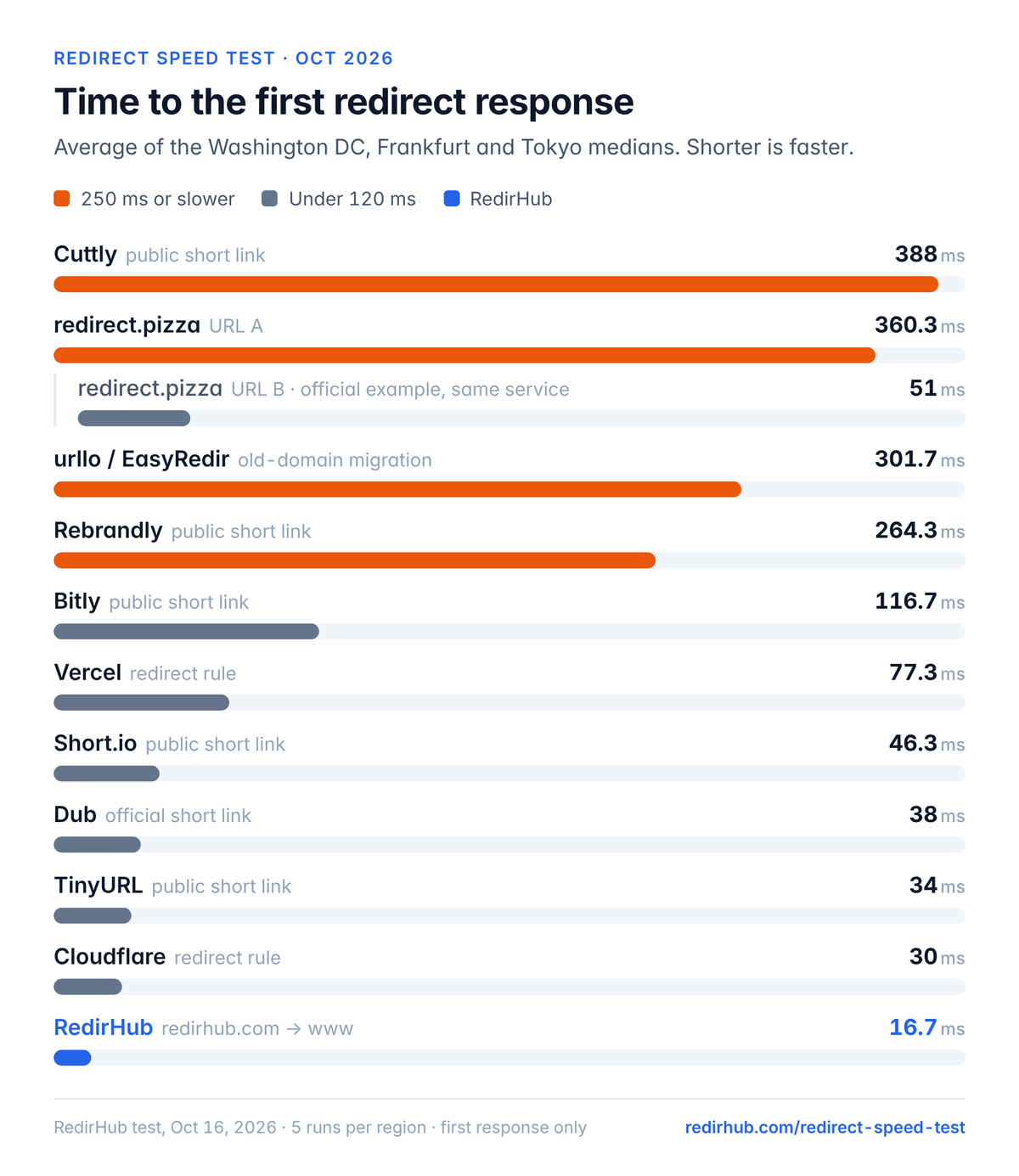
Average of the three regional medians, first response only. RedirHub test, Oct 16, 2026.
The ranking at a glance#
Times are in milliseconds (1,000 ms is one second) and show how long the redirect takes to answer before the visitor can move on; the technical name is time to first byte, or TTFB. Lower is better. redirect.pizza appears twice because we tested two of its links; only the first takes a rank.
| Rank | Service and URL type | DC / Frankfurt / Tokyo (ms) | Average (ms) | Status |
|---|---|---|---|---|
| 1 | Cuttly · public short link | 212 / 129 / 823 | 388.0 | 301 |
| 2 | redirect.pizza · URL A | 303 / 43 / 735 | 360.3 | 301 |
| — | redirect.pizza · URL B, same service (official example) | 30 / 12 / 111 | 51.0 | 301 |
| 3 | urllo / EasyRedir · old-domain migration (2 hops) | 179 / 428 / 298 | 301.7 | 301 |
| 4 | Rebrandly · public short link (3 hops) | 29 / 298 / 466 | 264.3 | 301 |
| 5 | Bitly · public short link (2 hops, one over HTTP) | 26 / 119 / 205 | 116.7 | 301 |
| 6 | Vercel · redirect rule we set up | 70 / 73 / 89 | 77.3 | 301 |
| 7 | Short.io · public short link | 15 / 15 / 109 | 46.3 | 302 |
| 8 | Dub · official short link | 39 / 35 / 40 | 38.0 | 302 |
| 9 | TinyURL · public short link | 29 / 29 / 44 | 34.0 | 301 |
| 10 | Cloudflare · redirect rule we set up | 30 / 35 / 25 | 30.0 | 301 |
| 11 | RedirHub · redirhub.com to www | 15 / 17 / 18 | 16.7 | 301 |
Under each link below is a screenshot of its own page on the speed test, so you can open it and run it again. We re-ran every page from all three regions, the same average the table uses. Live numbers move from run to run, so each caption gives both the re-run and the ranking-round figure. For chains with several hops we timed only the first hop; the extra hops cost your visitors more on top.
1. Cuttly: 388 ms#
A public Cuttly short link pointing to a Google Colab notebook. It returned a single 301 in all three regions, so there is nothing wrong with the setup. The cost is distance: 129 ms from Frankfurt, 212 ms from Washington DC and 823 ms from Tokyo, a 6× gap for the same link.
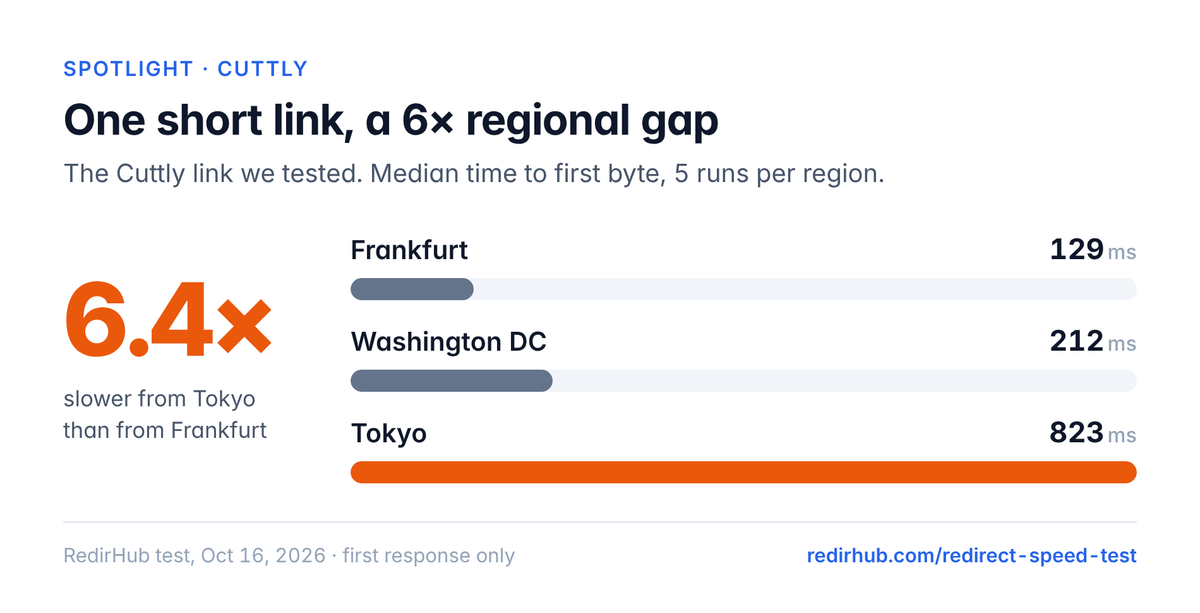
One short link, three regions. Median of 5 runs each.
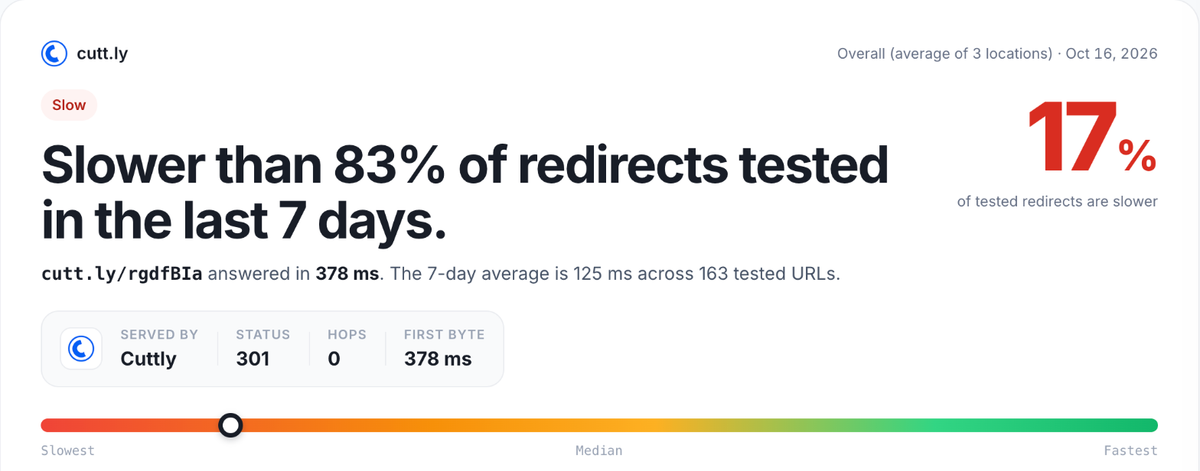
Speed test page for cutt.ly/rgdfBIa, re-run from all three regions on October 16, 2026: 378 ms (ranking round: 388 ms).
Open this test: cutt.ly/rgdfBIa
2. redirect.pizza: 360 ms and 51 ms#
This is the most surprising result. We tested two redirect.pizza links in the same round. Both returned one 301 with a valid certificate. URL A, test.redirect.pizza, averaged 360.3 ms and took 735 ms from Tokyo. URL B, the official example domain, averaged 51.0 ms.
redirect.pizza
URL A
360.3 ms
303 / 43 / 735 ms (DC / Frankfurt / Tokyo)
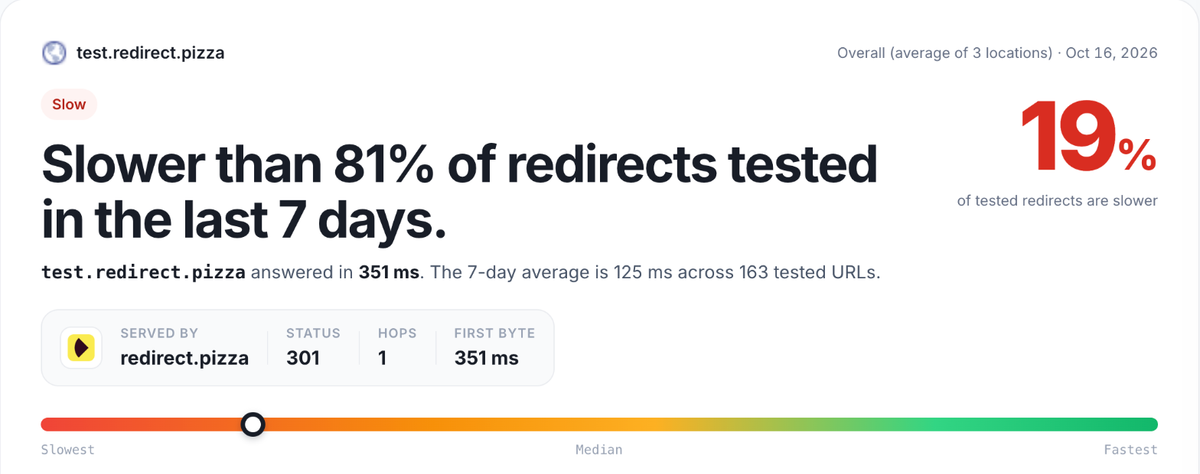
Speed test page for test.redirect.pizza, re-run from all three regions on October 16, 2026: 351 ms (ranking round: 360.3 ms).
Open this test: test.redirect.pizza
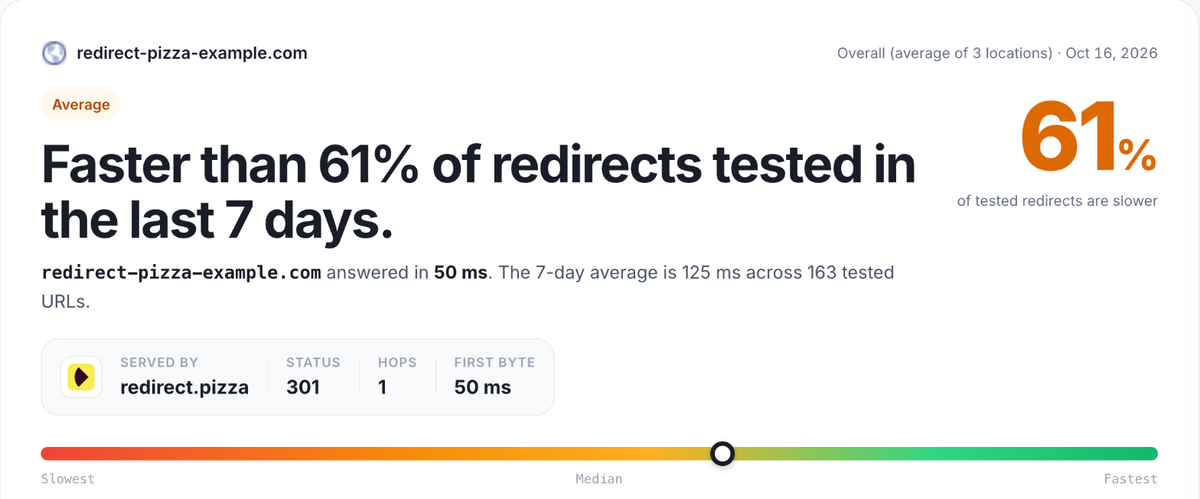
Speed test page for redirect-pizza-example.com, re-run from all three regions on October 16, 2026: 50 ms (ranking round: 51 ms).
Open this test: redirect-pizza-example.com
Picking only one of these would tell the wrong story about the service, which is why both stay in the ranking.
3. urllo (EasyRedir): 302 ms#
urllo's own old domain, easyredir.com, which redirects to the new brand. It is a site-migration redirect rather than a customer link: 179 ms from Washington DC, 428 ms from Frankfurt and 298 ms from Tokyo. It also takes two redirects before the final page (easyredir.com, then www.easyredir.com, then www.urllo.com), and we only timed the first.
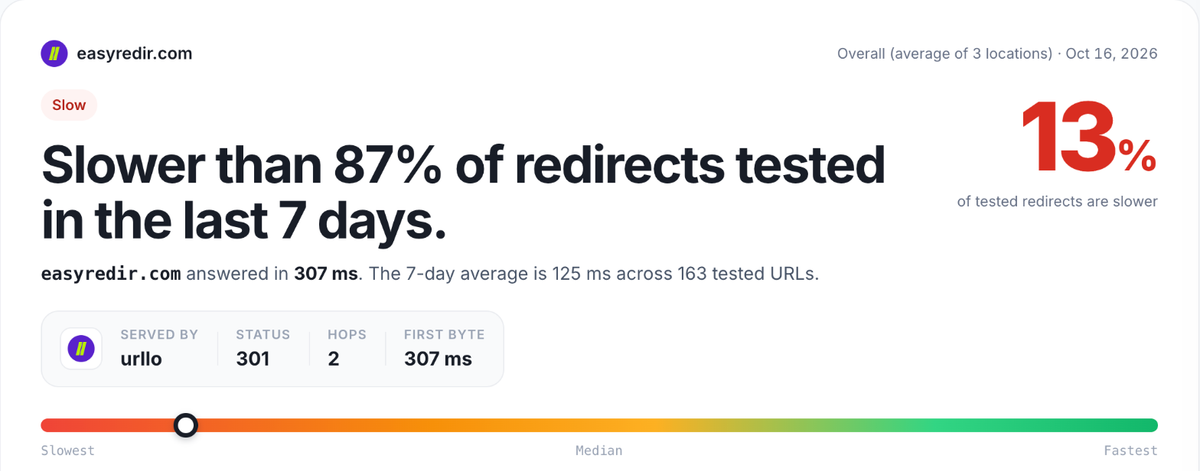
Speed test page for easyredir.com, re-run from all three regions on October 16, 2026: 307 ms (ranking round: 301.7 ms).
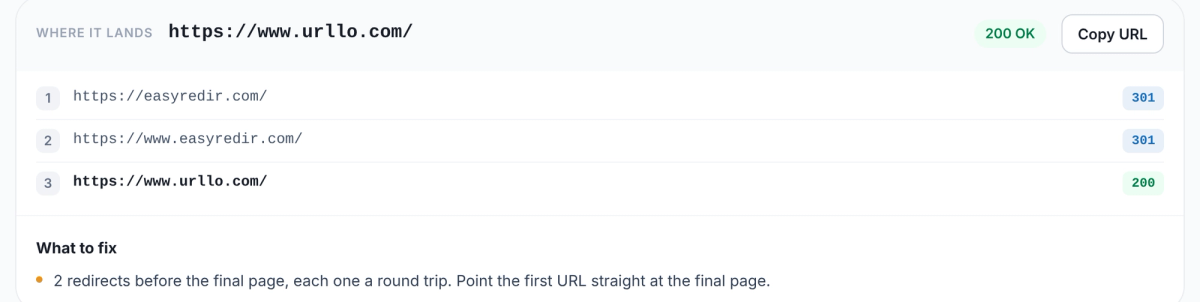
The chain behind it: two redirects before the final page.
Open this test: easyredir.com
4. Rebrandly: 264 ms#
A public Rebrandly short link. Fast from Washington DC (29 ms), much slower from Frankfurt (298 ms) and Tokyo (466 ms). It is also the longest chain in the test: three redirects, through two free-trial URLs with a click ID, before it lands on the pricing page.
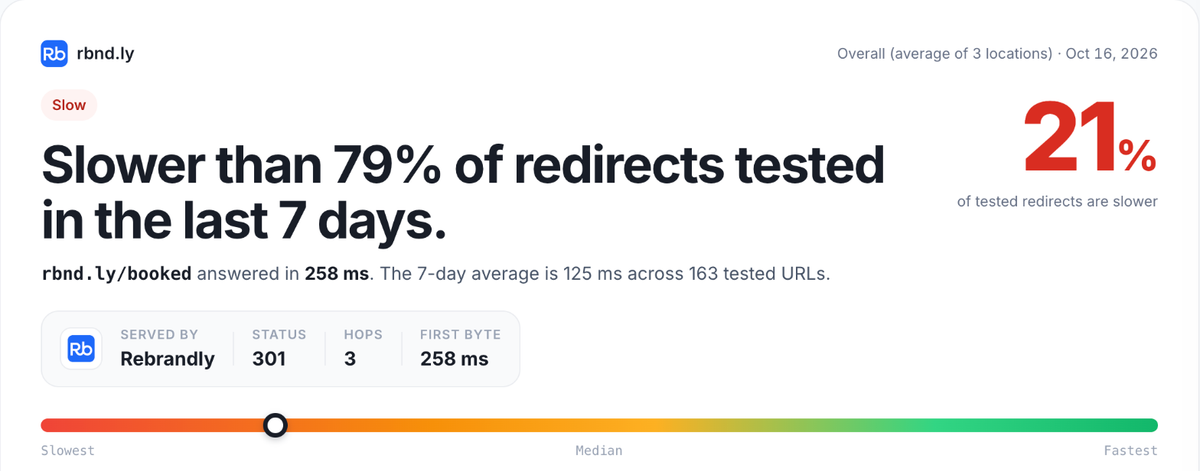
Speed test page for rbnd.ly/booked, re-run from all three regions on October 16, 2026: 258 ms (ranking round: 264.3 ms).
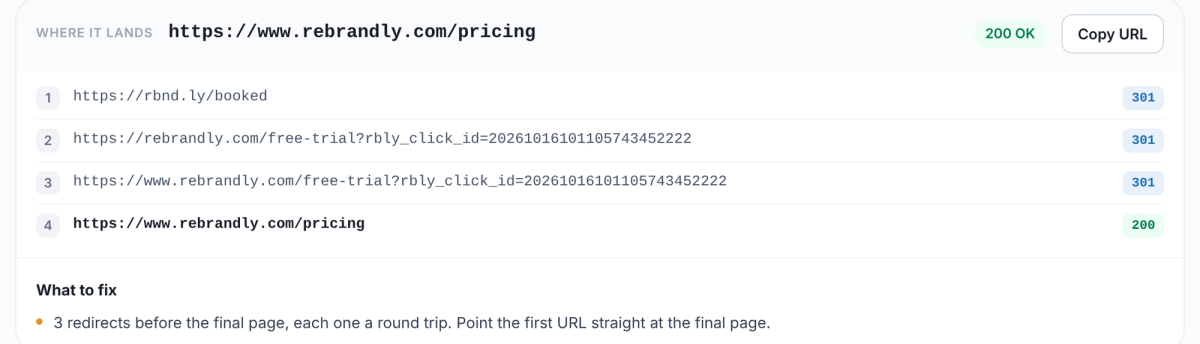
Three redirects before the final page, each one a round trip.
Open this test: rbnd.ly/booked
5. Bitly: 117 ms#
Bitly's own public example link. The first hop was quick from Washington DC (26 ms) and slower from Frankfurt (119 ms) and Tokyo (205 ms). The chain has a weak spot: the link sends visitors to an http:// YouTube address, which then has to redirect again to https://.
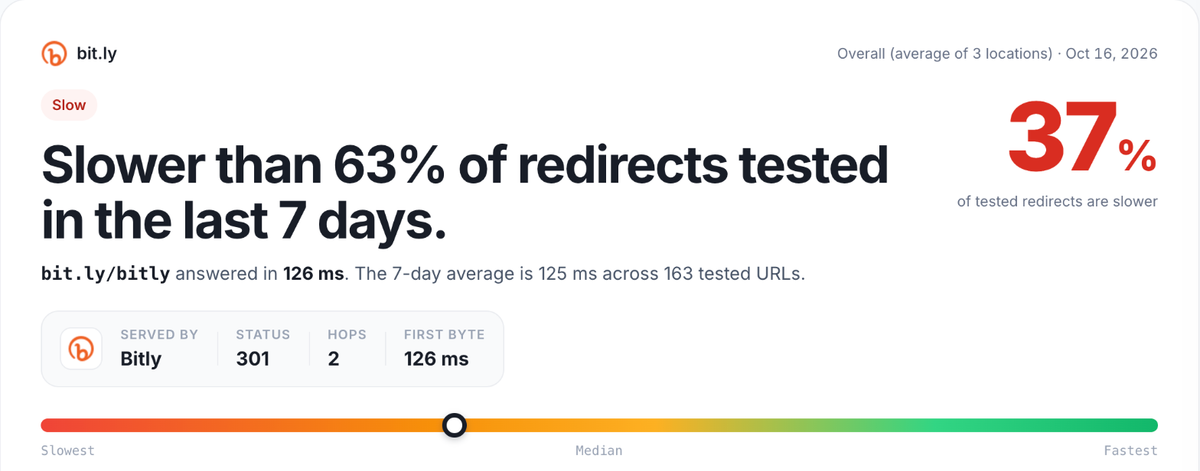
Speed test page for bit.ly/bitly, re-run from all three regions on October 16, 2026: 126 ms (ranking round: 116.7 ms).
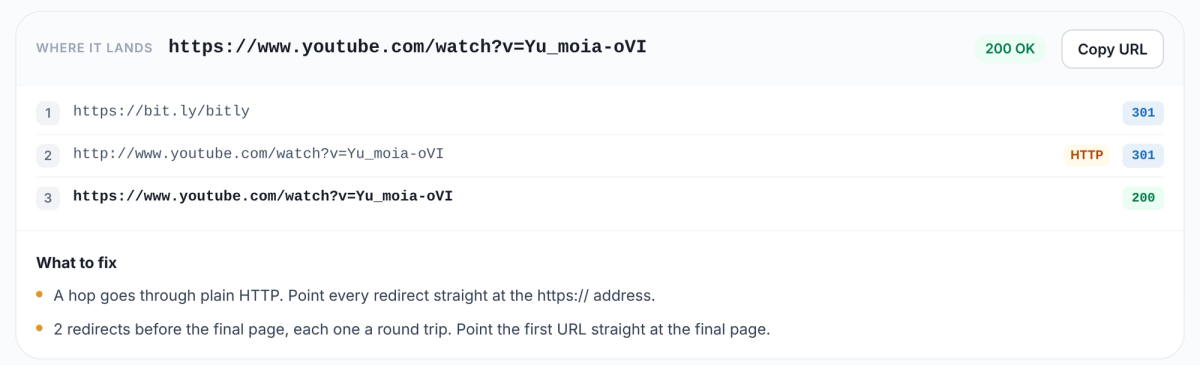
A hop over plain HTTP: slower, and one step is unencrypted.
Open this test: bit.ly/bitly
6. Vercel: 77 ms#
A redirect rule we set up ourselves on Vercel, pointing to our own site. Very even across regions (70, 73 and 89 ms), but each answer took a little longer than the edge-based services further down.
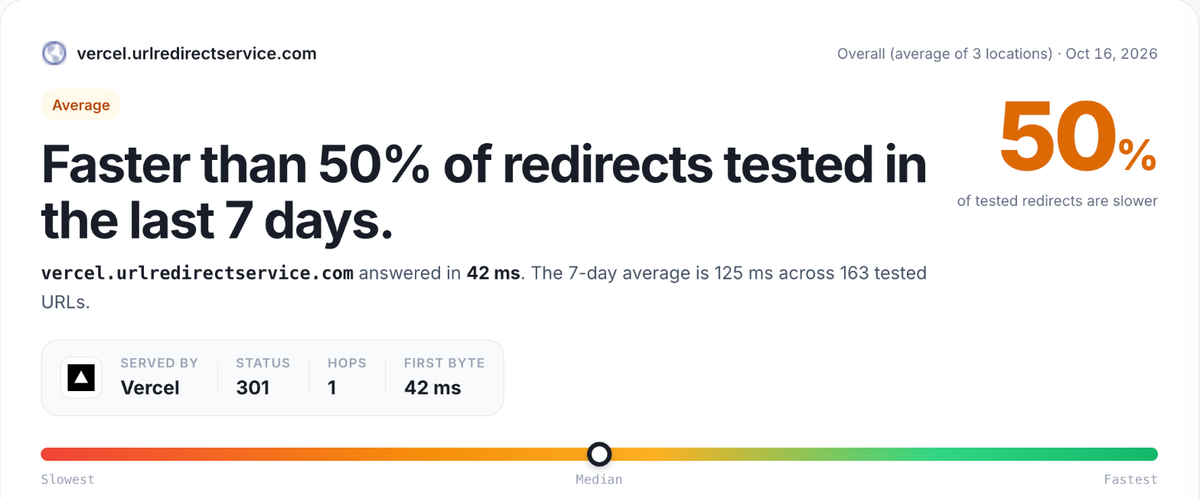
Speed test page for vercel.urlredirectservice.com, re-run from all three regions on October 16, 2026: 42 ms (ranking round: 77.3 ms).
Open this test: vercel.urlredirectservice.com
7. Short.io: 46 ms#
A public Short.io link used by a Colombian government agency. Very fast from Washington DC and Frankfurt (15 ms each) and slower from Tokyo (109 ms). It uses a 302, which is meant for temporary moves; the speed test flags that if the move is permanent.
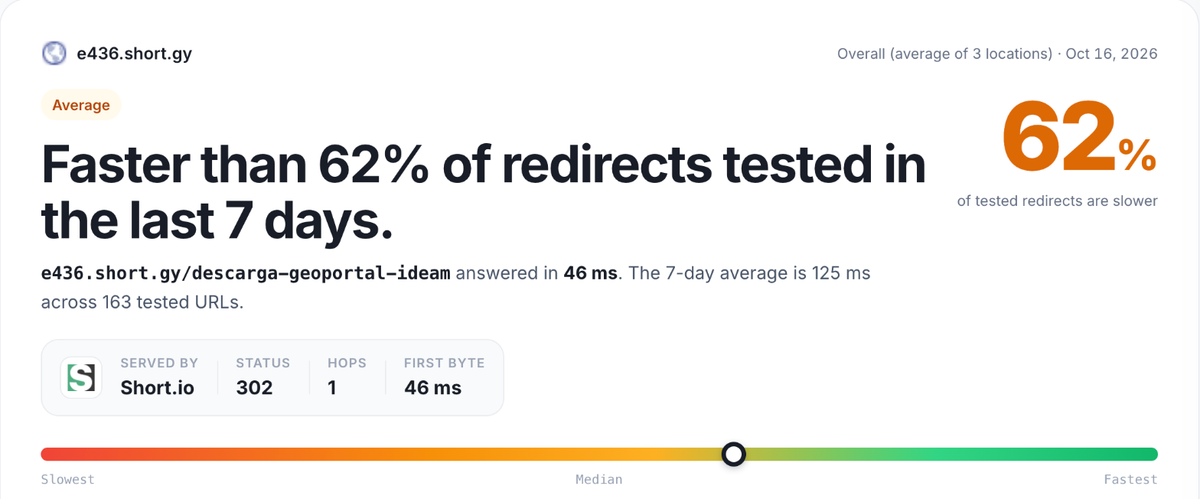
Speed test page for e436.short.gy/descarga-geoportal-ideam, re-run from all three regions on October 16, 2026: 46 ms (ranking round: 46.3 ms).
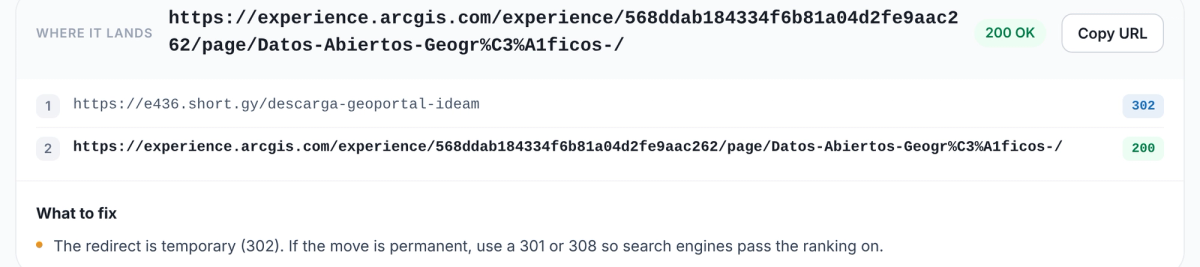
A 302 is temporary. For a permanent link, a 301 or 308 passes ranking signals on.
Open this test: e436.short.gy/descarga-geoportal-ideam
8. Dub: 38 ms#
Dub's official short link to its GitHub repository. Almost identical everywhere (39, 35 and 40 ms), which is what an edge-served redirect looks like. Like Short.io, it answers with a 302.
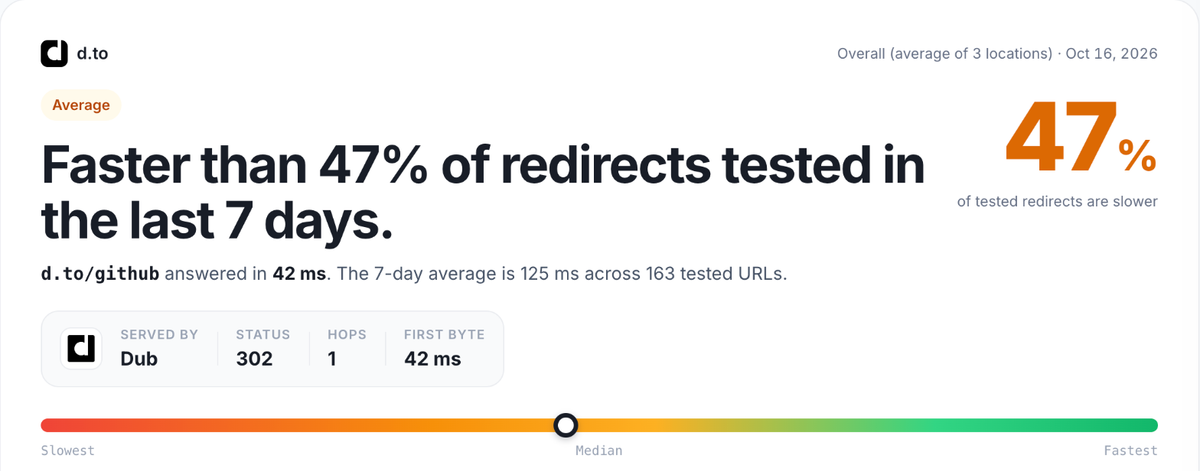
Speed test page for d.to/github, re-run from all three regions on October 16, 2026: 42 ms (ranking round: 38 ms).
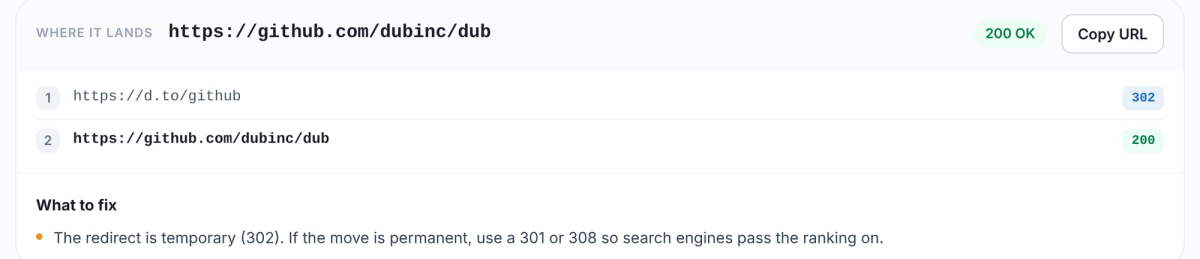
One hop, but a temporary 302.
Open this test: d.to/github
9. TinyURL: 34 ms#
A public TinyURL link to a YouTube video: 29 ms from Washington DC and Frankfurt, 44 ms from Tokyo. One clean 301, no extra hops.
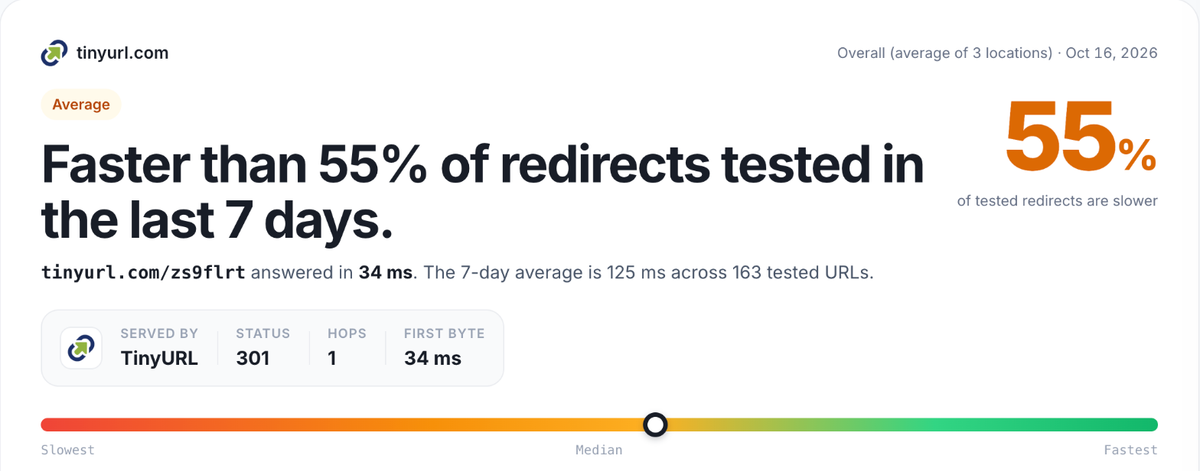
Speed test page for tinyurl.com/zs9flrt, re-run from all three regions on October 16, 2026: 34 ms (ranking round: 34 ms).
Open this test: tinyurl.com/zs9flrt
10. Cloudflare: 30 ms#
A redirect rule we set up on Cloudflare, pointing to our own site: 30, 35 and 25 ms. One of the most even results in the test, with Tokyo the fastest of the three.
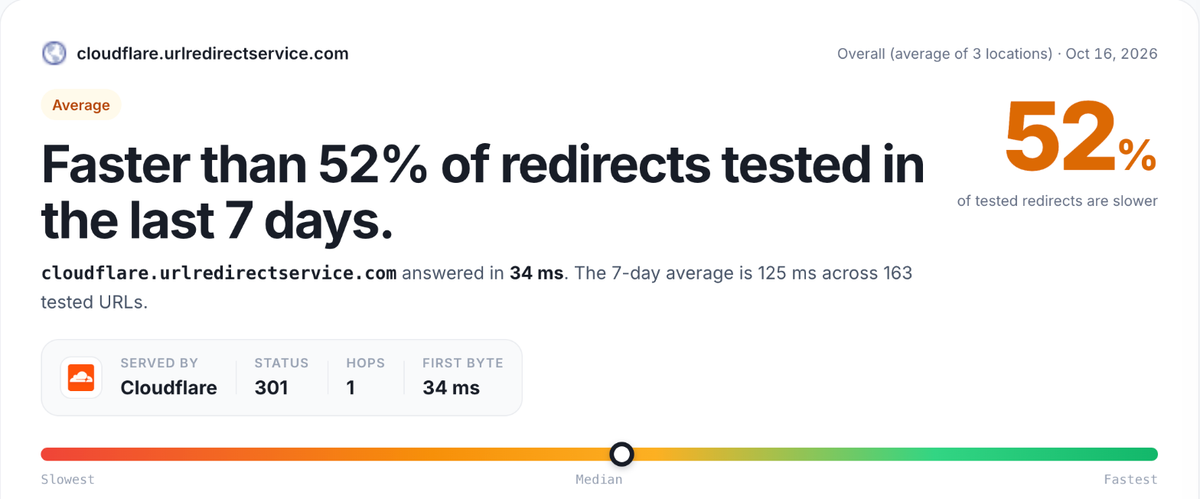
Speed test page for cloudflare.urlredirectservice.com, re-run from all three regions on October 16, 2026: 34 ms (ranking round: 30 ms).
Open this test: cloudflare.urlredirectservice.com
11. RedirHub: 17 ms#
Our own site redirecting redirhub.com to www.redirhub.com: 15, 17 and 18 ms. To be fair about it: this is our own site, not a customer's domain, and we ran the test ourselves. Treat it as one data point and check it with your own link.
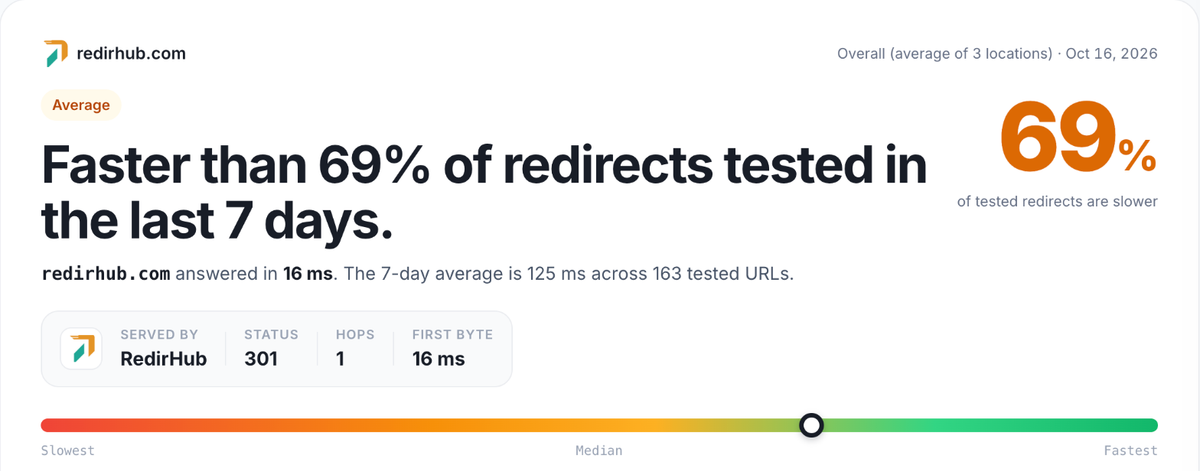
Speed test page for redirhub.com, re-run from all three regions on October 16, 2026: 16 ms (ranking round: 16.7 ms).
Open this test: redirhub.com
What we learned#
- Where your visitors are matters. The slowest links were fine from one region and slow from another: Cuttly went from 129 ms to 823 ms, Rebrandly from 29 ms to 466 ms. Test from the regions your audience is in, not just from your desk.
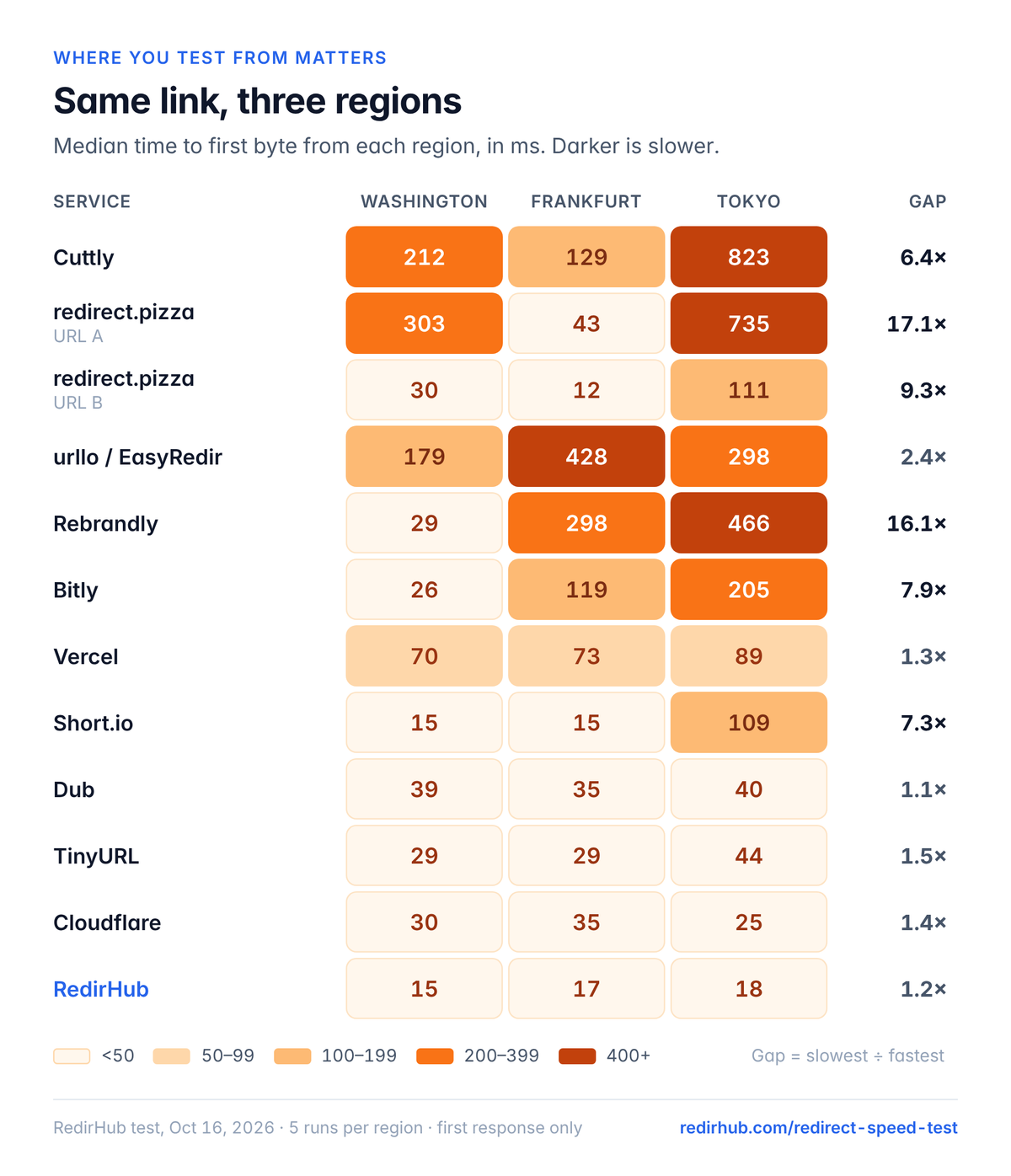
Darker cells are slower. Gap compares each link's slowest region with its fastest.
- One link is not the whole service. Two redirect.pizza links landed at 360 ms and 51 ms in the same round. Every number here describes one link at one moment; test your own.
- Hops add up. Rebrandly took three redirects, urllo and Bitly two, and Bitly's went through plain HTTP. Point each link straight at the final https:// page.
- Use the right code. Short.io and Dub answered with a 302, which is meant for temporary moves. For a link that never changes, a 301 is the clearer signal.
- The fastest look the same everywhere. TinyURL, Cloudflare, Dub and RedirHub stayed within a few milliseconds across all three regions.
For why this matters for users and SEO, see why redirect speed matters. For chains and broken redirects, see 301 redirect not working? 6 common causes and fixes.
Is your redirect on the slow end?
Paste your URL and see its time to first byte from Washington DC, Frankfurt and Tokyo, how it ranks against redirects tested in the last 7 days, and every hop in the chain. Free, no sign-up.
Test my redirectHow we tested#
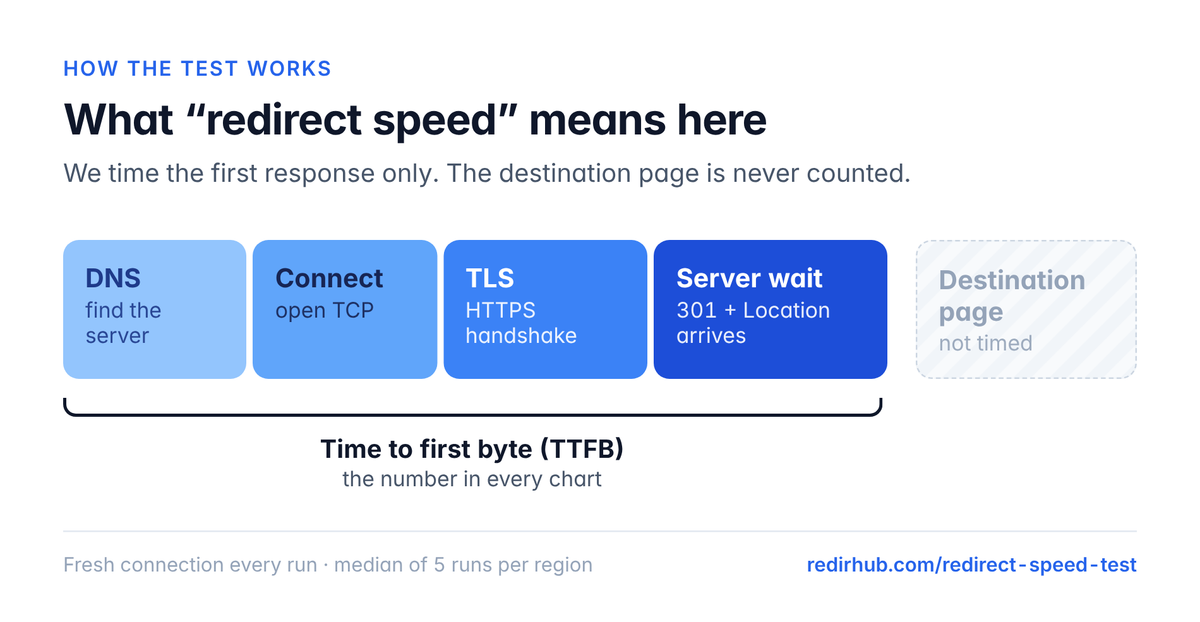
The number in every chart is time to first byte of the redirect response.
- Date: October 16, 2026. Main samples were tested between 09:18 and 09:22 UTC, RedirHub at 09:31 UTC and the paired redirect.pizza URLs together at 09:33 UTC.
- Regions: Washington DC, Frankfurt and Tokyo. Five runs per region, each on a fresh connection; we report the median.
- Metric: time to first byte of the first response only. The destination page is not timed, so a slow destination does not count against the redirect.
- Ranking: the plain average of the three regional medians, so each region counts equally.
- URLs: public short links found in published sources, official examples, two redirect rules we set up ourselves on Cloudflare and Vercel, and redirhub.com. Destinations, plans and settings were not the same across services.
- Left out: a redirection.io customer deployment that returned 403 in two of the three regions (blocked responses are not faster redirects), and self-hosted setups such as NGINX, Apache, Caddy and WordPress plugins, whose speed depends on the server they run on. We have not yet tested registrar domain forwarding.
- Who ran it: RedirHub. This is a short snapshot of specific URLs, not a long-term performance ranking of any brand, and it says nothing about SEO or conversion on its own.
Check your own redirect in 30 seconds#
Step 1. Open the redirect speed test and paste your redirect or short link.
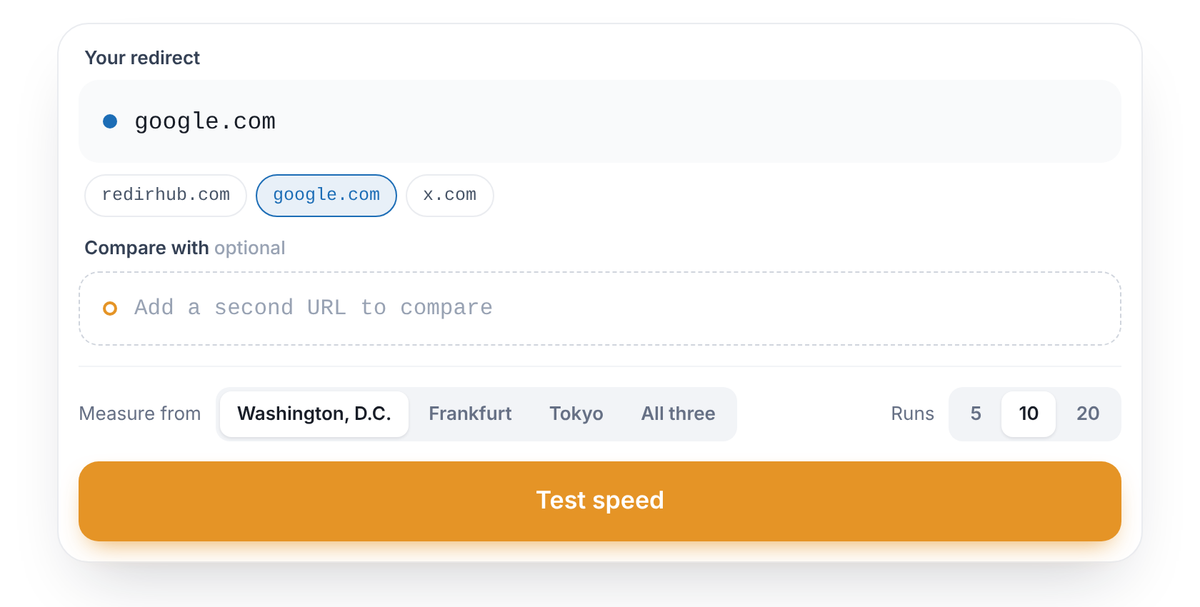
Paste a link, pick a region (or all three) and press Test speed.
Step 2. Pick All three regions, so you see the gap between continents, not just the one closest to you.
Step 3. Add a second URL to compare, for example your current provider against a test redirect. Both get the same runs, alternating, from the same place.
Step 4. Read the result card and the What to fix list, like the screenshots above: extra hops, a 302 where a 301 belongs, a hop over plain HTTP or a broken destination.
Step 5. Share the result page or download its image, or copy the curl command to repeat the test from your own machine.
Prefer the terminal? This prints the median of 10 runs for a URL, with DNS, connect, TLS and first byte. Your numbers will differ from ours, because they depend on where you run it.
bashfor u in 'https://your-redirect.example/'; do
  for i in $(seq 10); do
    curl -s -o /dev/null --max-redirs 0 --max-time 10 \
      -w '%{time_namelookup} %{time_connect} %{time_appconnect} %{time_starttransfer} %{http_code}\n' "$u"
  done | sort -n -k4 | awk -v u="$u" '{r[NR]=$0} END{split(r[int((NR+1)/2)],m," ");
    printf "%-28s %s  DNS %4.0f  connect %4.0f  TLS %4.0f  first byte %4.0f ms\n", u, m[5], m[1]*1000, (m[2]-m[1])*1000, (m[3]>0?m[3]-m[2]:0)*1000, m[4]*1000}'
done
Found a slow or chained redirect? Move it to RedirHub and test it again.
Create a redirectSources
Frequently asked questions
In our October 16, 2026 test, the Cuttly short link we tested was slowest, averaging 388 ms across Washington DC, Frankfurt and Tokyo, with 823 ms from Tokyo. That describes one URL at one moment, not every Cuttly link.
The four fastest redirects in our test answered in 15 to 44 ms from all three regions. What matters most is a small gap between regions and a single hop: a redirect that is fast near its server but several hundred milliseconds away from it will feel slow to part of your audience.
A redirect adds a request before the real page loads, so a slow one makes the page slower for visitors, and chains add one request per hop. This test measures speed only; it does not show a direct effect on rankings.
Distance to the server, your network and DNS caching all change the result. Compare URLs tested from the same place at the same time, and look at the gap between them rather than the absolute values.
We tested two of its URLs in the same round and got 360.3 ms and 51.0 ms. Showing only one would misrepresent the service, so both appear, and only the first takes a rank.
We ran it, so we say so. The RedirHub sample is our own site's redirect, not a customer setup, and the method, times and URLs are published so anyone can rerun the test with the free tool or the curl command.

Leo Astarothman is the Brand & Content Lead at RedirHub, where he shapes the company's visual identity, educational content, product experiences, and marketing strategies. He also specializes in system design. Simplifying complex redirect infrastructure into practical resources, product experiences, and campaigns that help businesses understand and adopt modern redirect management.
Related Articles
View All Articles