Multi-Brand Domain Strategy: A Practical Playbook

Key takeaways
Give a brand its own domain only when it has a distinct audience and its own goals. If two properties share most of their audience, consolidation usually builds more authority. Keep ownership central. Delegate specific DNS tasks to franchisees or regional teams, never the registration itself. Point every unused domain somewhere deliberate with a 301 redirect, and track renewals so none lapse. Treat any merge or move as a phased migration. Poorly executed ones commonly lose 20% to 60% of organic traffic. Put short links and QR codes on domains you control, so destinations can change without reprinting anything.
A good multi-brand domain strategy comes down to three decisions. Which brands deserve their own domain, who owns and controls every domain, and where each unused or secondary domain points. Get those three right and the rest, from SEO to franchise governance, becomes routine. Get them wrong and you end up with a sprawl of expiring registrations, mismatched links and printed materials that point nowhere.
This guide is for marketers, brand operations teams and in-house IT groups who manage several brands, regions or franchise locations. It covers how to decide between separate domains and one consolidated structure, how to run ownership and DNS across a portfolio, and what to do with the domains you own but do not use.
Start with a brand map, not a domain list#
Most portfolios grow by accident: an acquisition here, a campaign microsite there, a defensive purchase nobody documented. Before deciding anything, catalog what exists. MarkMonitor describes brand domain management[1] as starting with a brand map: every corporate brand, product brand, regional variant, marketing campaign and planned launch that needs domain coverage.
Build one spreadsheet with these columns:
| Column | What to record |
|---|---|
| Domain | Exact name and TLD |
| Brand or campaign | Which brand it serves |
| Registrant and registrar | Legal entity, account owner, login holder |
| Renewal date | Plus whether auto-renew is on |
| Status | Live site, redirect, parked, or unknown |
| Traffic and inbound links | From analytics and backlink tools |
| Decision | Keep, redirect, consolidate, or drop |
The “unknown” rows are where the risk lives. A domain with inbound links and no owner is an asset someone else can eventually register.
Separate domains or one structure: how to decide#
The core question is whether each brand needs its own search authority and identity, or whether brands benefit from sharing one.
When separate domains make sense#
A separate domain fits when brands serve different audiences, have different goals, or must look unrelated to customers. A luxury line and a value line from the same parent are the classic case. So are regional brands with different languages and legal entities. Keep shared assets such as forms and calls to action cleanly separated when brands have different goals.
When to consolidate#
One published 2026 guidance from Technova Partners suggests[2] that when two web properties share more than 30% of their target audience, a single domain with subdirectories typically generates more SEO value than separate domains. Treat that as a rule of thumb rather than a law: it is one firm’s view, and your own analytics on audience overlap should drive the call.
A quick decision table#
| Situation | Usual answer |
|---|---|
| Two brands, heavily overlapping customers | Consolidate under one domain |
| Distinct audiences, distinct positioning | Separate domains |
| Regional variants of one brand | Subdirectories or country domains, one owner |
| Franchise locations | One brand domain, location pages or controlled subdomains |
| Campaign or event | Subdomain or path, or a short-lived domain redirected afterward |
| Defensive and typo domains | Register, then 301 to the main site |
Does the TLD matter?#
Less than people think. A summary of Google’s stance[3] says most gTLDs are treated the same and a TLD does not boost rank. It also advises that if you run two TLDs, you pick one main site and 301 redirect the other. The practical reason to own several extensions is protection and customer trust, not ranking.
Governing domains across franchises and regions#
Franchise networks are where domain management most often goes wrong, because the people running the local business are not the people who own the brand. IP Twins advises[4] that the franchise agreement should explicitly say the franchisor retains ownership of all domain names. Centralized control also helps the franchisor apply security measures and stop misuse of its trademarks.
A workable model has four parts:
- The franchisor registers everything. Brand domains, location domains and obvious variations sit under the corporate registrant account.
- Franchisees get delegated access, not ownership. That can mean a subdomain or a location path, plus perhaps email, within technical rules the franchisor sets.
- The agreement says what happens at exit. The domain stays, and the location page or redirect is reassigned.
- Naming is standardized. For example, one pattern for every location, so customers and search engines learn it.
This same logic applies to agencies running domains on behalf of clients and to business units inside large companies. If ownership is unclear on paper, it will be unclear on the day someone leaves.
Treat domains as legal assets#
It is tempting to hand domains to IT as a utility. Brand-enforcement practice treats trademark protection and enforcement[5] as one plan, and domain names belong in it: searches, filings and enforcement are decided together. That mindset changes your checklist.
- Track renewals centrally. IPzen lists renewal tracking[6] among the core tasks of domain portfolio management, alongside monitoring similar registrations and using UDRP procedures against cybersquatting.
- Consider the Trademark Clearinghouse for your top brands. Registering marks there gives priority access during sunrise periods for new gTLDs.
- Monitor lookalikes. Typo and lookalike domains can feed phishing and fraudulent redirects. Registering the likeliest variants costs far less than a takedown.
What to do with unused business domains#
Every portfolio has them: the old product name, the campaign that ended, the typo you bought defensively. Leaving them parked on a registrar page wastes traffic and can look careless. You have four honest options.
- Redirect to the closest relevant page. Not always the homepage. Send an old product domain to the replacement product page.
- Redirect typo and defensive domains to the main brand site. Type-in visitors who mistype your name still arrive. See how to redirect typo domains and manage brand domains, including country-code variants.
- Keep and park a bulk set. For large portfolios, domain parking with bulk redirects over HTTPS keeps every name resolving securely without hosting a site on each.
- Drop it deliberately. If the domain has no traffic, no backlinks and no trademark relevance, letting it expire is fine. Decide this on purpose, after checking that nothing printed or embedded still points to it.
The last check matters more than it sounds. Old domains hide in PDFs, packaging, email signatures and QR codes. Before dropping one, confirm nothing live depends on it.
How fast should a spare-domain redirect be?#
A redirect on a spare domain is often the first thing a visitor meets, so its speed counts. In RedirHub’s redirect speed benchmark for 15 to 22 October 2026[7], which measured 25 providers from Washington, D.C., Frankfurt and Tokyo, RedirHub’s redirects had a median time to first byte of 16 ms. That ranked third of the 25, behind Fastly at 12 ms and Microsoft Azure at 15 ms. A redirect layer on your own domains need not add a noticeable delay.
Consolidating without losing traffic#
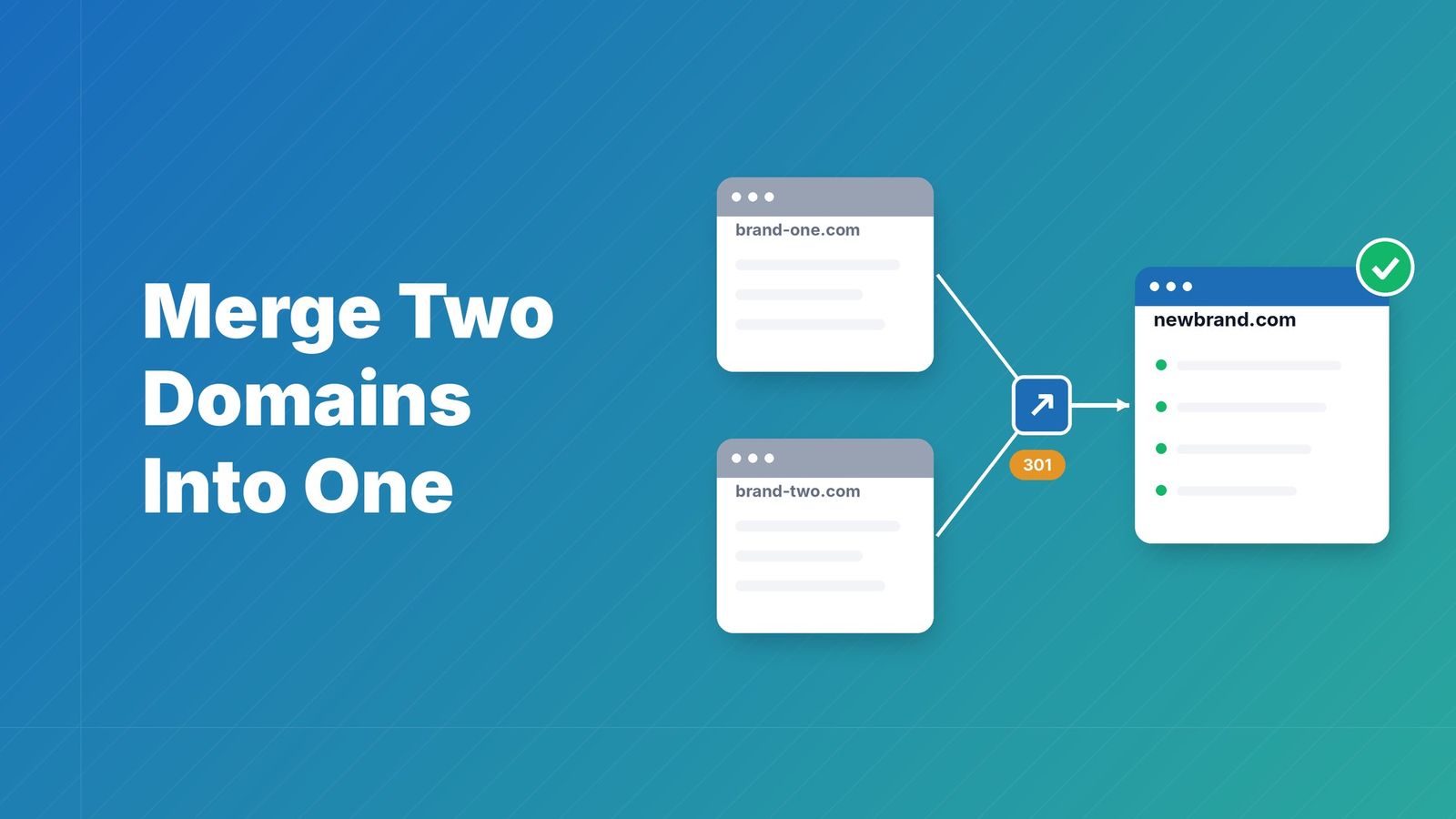
Merging brands or domains is the riskiest move in this playbook. According to Technova Partners[2], poorly executed migrations often cause organic traffic drops of 20% to 60%, with recovery taking 6 to 18 months. Their recommendation is to move in phases by section, low-traffic pages first, instead of flipping everything in one day.
The same source offers a technical rule worth memorizing: do not rely on canonical tags alone during an initial migration, because 301 redirects are structurally stronger for consolidating authority. Canonical tags are better kept for syndicated content that should point to a primary version.
A safe sequence:
- Export every URL on the old domain that has traffic or links.
- Map each to its closest equivalent on the new domain, page to page.
- Launch redirects for a low-traffic section first and monitor.
- Roll out remaining sections in phases.
- Update internal links, sitemaps and external profiles to the new URLs.
- Keep the old domain registered and redirecting long after the move.
For detail on each step, see our guides to using redirection to merge domains, SEO domain changes and redirecting a website after an acquisition.
Our perspective: control the layer customers touch#
Most multi-brand advice stops at the website. We think the bigger risk sits one layer out, in everything that points to the website: short links in campaigns, QR codes on packaging, redirects from old domains. These live on whatever domain happened to be convenient, often a shared shortener the company does not control.
When a brand is sold, merged or renamed, the website can be migrated in a quarter. A printed QR code or a link in a thousand PDFs cannot. That is why we built RedirHub around the company’s own domain: links and redirects run on domains you own, secured with SSL, and destinations can be changed without touching printed materials. For teams managing several brands, that turns a pile of one-off decisions into a single, auditable layer.
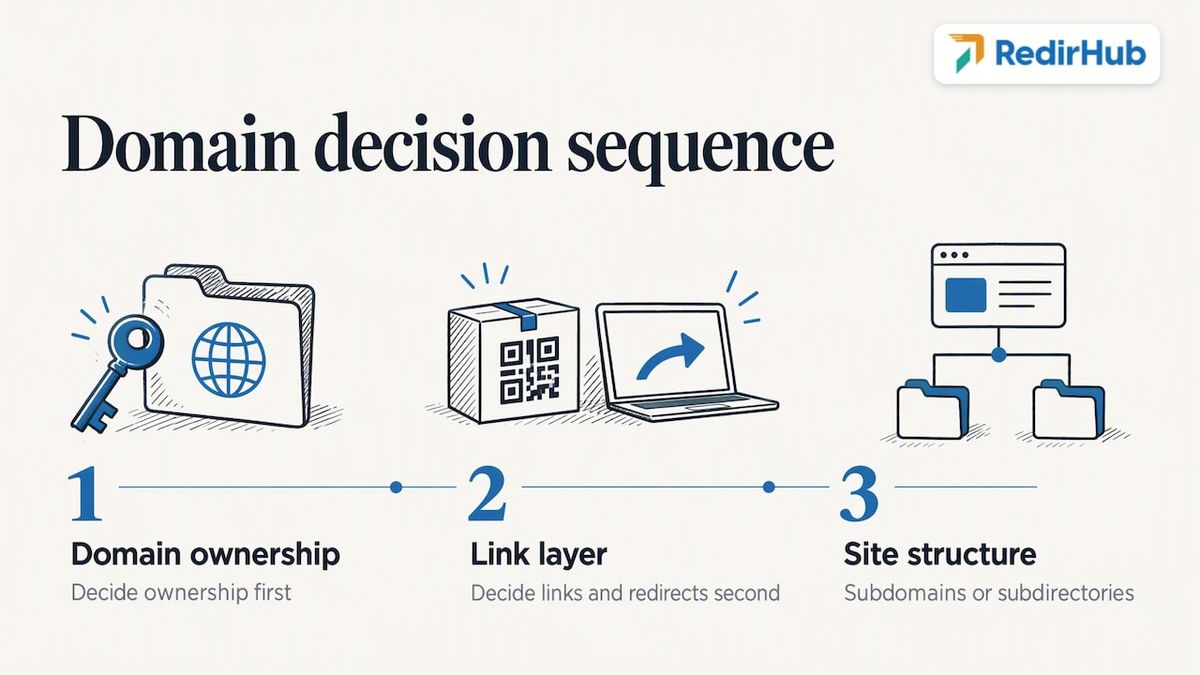
Our advice to brand operations teams is simple. Decide domain ownership first. Decide the link and redirect layer second. Only then argue about subdomains versus subdirectories, because that argument is easier to revisit than a thousand dead printed links.
Short links and QR codes in a multi-brand setup#
Every brand needs to look like itself in campaigns. A link on a generic shortener says nothing about who sent it. A link on the brand’s own domain does, and it stays under your control. Branded short links for every channel lets each brand use its own domain, and dynamic QR codes let you change where a printed code lands after it is in the world.
That is especially useful for franchises and agencies: a seasonal offer ends, and you repoint the code instead of reprinting.
Putting RedirHub to work#
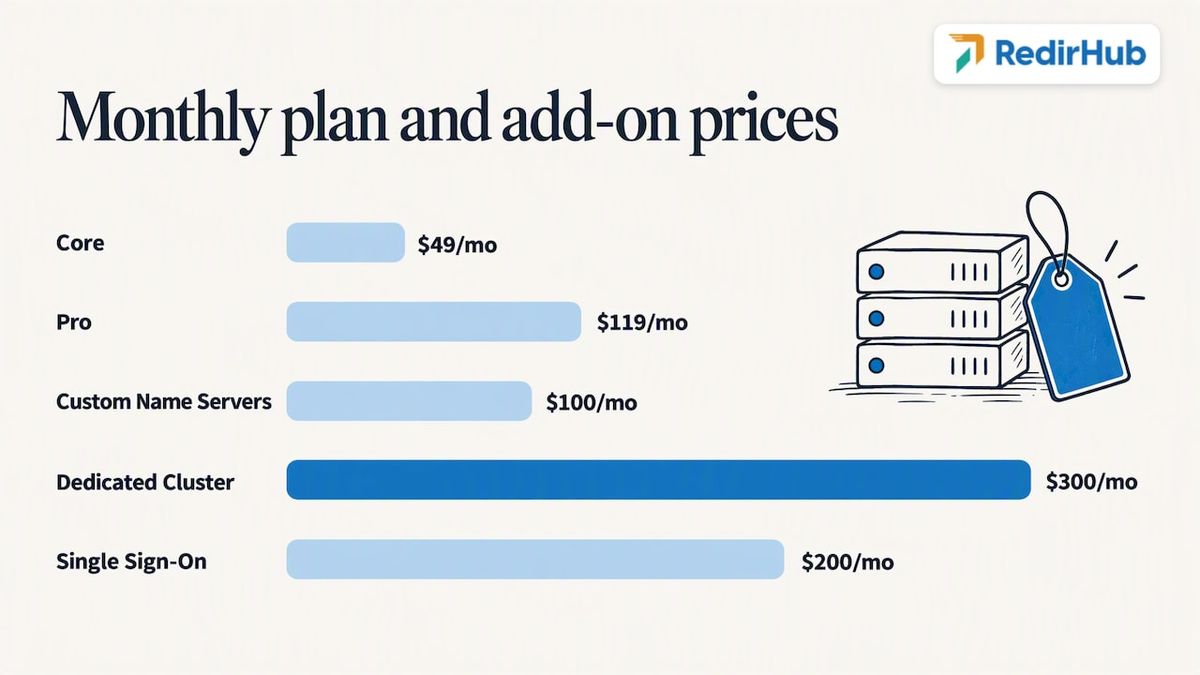
If your portfolio has many domains, multiple brands and long-lived links, RedirHub covers the redirect layer in one place: branded links, dynamic QR codes, domain redirects and website migrations, with SSL management, bulk operations and analytics for link and QR engagement. Plans on the pricing page start with Core at $49 per month and Pro at $119 per month; Enterprise is set by contract. On Pro, add-ons include Custom Name Servers at $100 per month, Dedicated Cluster at $300 per month and Single Sign-On at $200 per month.
Keeping the system healthy#
A strategy is only as good as its upkeep. A quarterly routine is enough for most teams:
- Reconcile the brand map against registrar accounts.
- Check renewal dates for the next 90 days.
- Review redirect analytics to see which old domains still get traffic.
- Test a sample of printed-material links and QR codes.
- Confirm franchisee and agency access still matches who works there.
A brand check helps too. Future Ventures’ branding guide[8] lists the 5 C’s of branding: clarity, consistency, credibility, connection and commitment. Consistency is the one domains affect most. If a customer lands on a site that looks unlike the one they expected, trust drops. The 3-7-27 rule[9] of repeated exposure, as Simon-Kucher puts it, moves customers from noticing a brand to recognizing it to choosing it, so every link and redirect in the chain should feel like the same company.
Put every spare brand domain to work
Point typo, defensive and retired brand domains at the right page with 301 redirects over HTTPS, and manage them all from one dashboard. Core and Pro come with a 14-day free trial.
Redirect your spare domainsSources
- [1]Domain Name Risk Management: How to Protect Your Corporate Portfolio
- [2]Enterprise Technical SEO in 2026: Challenges at Scale and Governance
- [3]Do Different TLDs Impact SEO? What Google Actually Says | Sketchweb Microblog
- [4]Keys To Handling Domain Names in Franchise Agreements - IP Twins
- [5]Capabilities - Winston Taylor
- [6]IP portfolio management: the complete 2026 guide - IPzen
- [7]RedirHub redirect speed benchmark, 15 to 22 October 2026
- [8]Brand Your Business: Essential Strategies for Effective Branding
- [9]A strategic guide to brand growth
Frequently asked questions
Only if the brand has a distinct audience, positioning or legal identity. If audiences overlap heavily, one structure with subdirectories usually concentrates authority better. Check your analytics for overlap before you buy anything.
Keep registration with the franchisor and state that in the franchise agreement. Delegate only specific DNS tasks, such as a location subdomain, within rules you set. Use one naming pattern across locations.
Redirect them with 301s to the most relevant page, usually the main brand site or a replacement product page. Keep defensive and typo domains registered and redirecting. Drop a domain only after confirming it has no meaningful traffic, links or printed references.
Properly configured 301 redirects are the standard way to consolidate an old or duplicate domain into a main one. Problems come from redirecting everything to the homepage, skipping page-level mapping, or moving everything in a single day. Phase the move and monitor traffic.

Leo Astarothman is the Brand & Content Lead at RedirHub, where he shapes the company's visual identity, educational content, product experiences, and marketing strategies. He also specializes in system design. Simplifying complex redirect infrastructure into practical resources, product experiences, and campaigns that help businesses understand and adopt modern redirect management.
Related Articles
View All Articles