

Key takeaways
Static QR codes are free to generate, but they cannot be edited or tracked after printing. Dynamic QR code plans commonly start at a few dollars a month and climb to $60 or more; annual billing lowers the monthly rate noticeably. The costliest mistake is not the subscription. It is printing codes that die when a trial or plan lapses. For business use, compare plans on code ownership, domain control and exit terms, not only on price per month. Our own plans start at $49 per month (Core) and $119 per month (Pro); Enterprise is set by contract.
A static QR code costs nothing. A dynamic QR code, the kind you can edit and track, is a subscription. Entry-level plans typically run $4.99 to $60 per month on monthly billing, with a median near $11.26[1], and the sticker price is rarely the number that matters. What matters is what happens to your printed codes if you stop paying.
This guide breaks down what QR codes cost, what you get at each price level, where the hidden costs sit, and how to budget if you run campaigns for a business or several clients.
What a QR code actually costs: free versus paid#
There are two kinds of QR code, and the price gap between them explains almost everything on pricing pages.
A static QR code stores the destination directly in the pattern. Nothing sits in the middle, so there is nothing to host and nothing to bill. That is why static codes can be generated for free[1]. The trade-off: the destination is fixed forever, and you get no scan data.
A dynamic QR code points to a short redirect address, and that address points to your destination. The redirect is a service someone has to run, which is why dynamic codes carry a subscription. In return you can change the destination later and see how many people scanned. If you want the full comparison, we wrote it up in static vs dynamic QR codes.
| Static | Dynamic | |
|---|---|---|
| Typical cost | Free | Monthly or annual subscription |
| Edit destination after printing | No | Yes |
| Scan analytics | No | Yes |
| Depends on a vendor staying online | No | Yes |
| Best for | Wi-Fi details, plain text, one-off personal use | Print campaigns, packaging, signage, anything long-lived |
The last row of the dynamic column is the one buyers overlook. We come back to it below.
Dynamic QR code pricing in 2026#
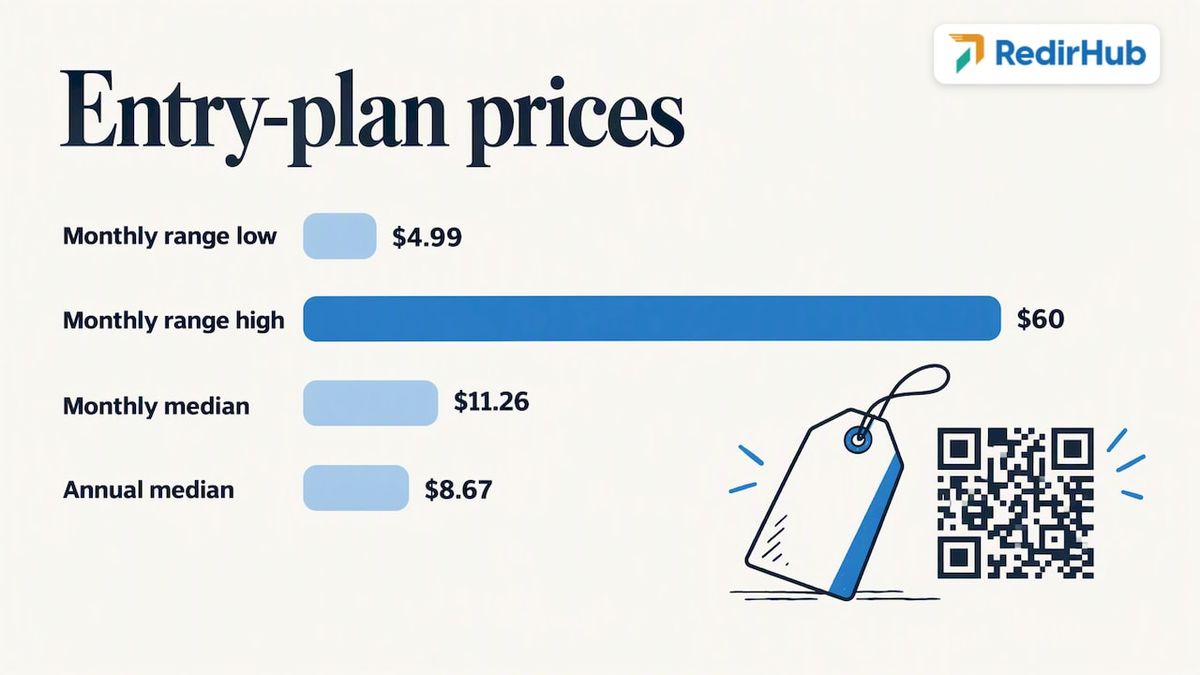
Published price indexes give a realistic range. In QRBench’s index, updated in August 2026, monthly-billed entry plans across eight major platforms ran from $4.99 to $60, with a median of $11.26[1]. On annual billing, the same index shows the median entry price falling to about $8.67 per month.
Other sources put the floor lower. One comparison of free and paid generators says paid dynamic plans start around $1.20 to $8 per month[2] for individuals and small businesses. Treat that as the bottom of the market: single-code or small-quota plans aimed at hobbyists and local shops.
Why the spread is so wide:
- Number of codes. Cheap plans cap how many dynamic codes you can hold.
- Scan limits. Some plans cap scans and disable codes past the cap.
- Analytics depth. Basic scan counts are cheap; location, device and campaign-level reporting cost more.
- Branding and domain. Most low-cost plans route scans through the vendor’s shared domain. Using your own domain is usually a higher-tier feature.
- Team features. Roles, single sign-on, API access and bulk creation push plans toward the upper end.
If you are a marketer running a handful of campaigns, the middle of that range is realistic. If you manage many brands or thousands of codes, you are in custom-quote territory, and the question becomes which vendor gives you the most control for the money.
The hidden cost: codes that stop working#
This is where QR code pricing becomes expensive.
A dynamic code is only as alive as the plan behind it. Reporting on the practice describes a pattern in which codes stop resolving the moment a trial expires or a subscription lapses[3], often under terms customers do not read until the materials are already in the field. The same article notes that a single commercial print run for product labels can cost $5,000 to $40,000[3]. A $10 monthly saving looks small next to a reprint.
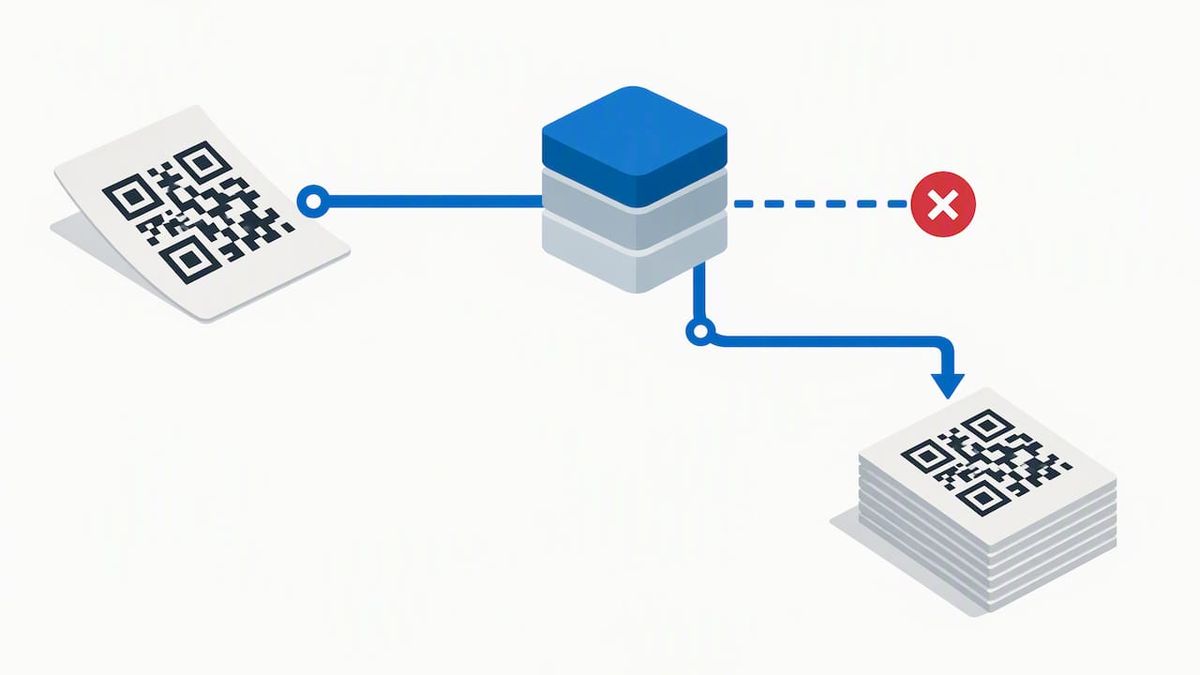
Another write-up lists examples of platforms with short trials and scan caps that deactivate codes[4], and describes what a fairer arrangement looks like: a permanent free tier, codes that keep working after cancellation, no scan caps that disable codes, and deletion as the only way a code stops. Whether or not you agree with every example there, those are good questions to put to any vendor.
For a deeper look at what actually breaks and when, see do QR codes expire and why your QR code stopped working.
Questions to ask before you print#
- What happens to my codes if I downgrade, cancel or miss a payment?
- Is there a scan cap, and does hitting it disable the code or only the reporting?
- Does the code run on my domain or the vendor’s? If it is the vendor’s, you cannot move it.
- Can I export my codes and their redirect rules?
- Is the trial price the same as the plan I will need, or does the feature I want sit one tier up?
A vendor that answers these plainly is worth more than one that is $3 cheaper.
What to budget by use case#
These are planning ranges drawn from the published figures above, not quotes from any vendor.
| Situation | What you need | Budget logic |
|---|---|---|
| One-off flyer or event, never changes | Static code | $0 |
| Small business menu or signage that may change | A few dynamic codes with basic tracking | Entry-tier plan, roughly the $4.99 to $60 monthly range, median about $11.26 |
| Marketing team, recurring print campaigns | Dozens of codes, campaign-level analytics | Mid-tier plan; weigh annual billing, which lowers the median entry rate to about $8.67 per month |
| Agency with multiple clients | Branded domains, team access, bulk creation | Business tier or custom quote; control and exit terms matter most |
| Brand with packaging and long-lived labels | Codes that must outlive any campaign | Your own domain, so the code never depends on a vendor’s address |
One more factor: the cost of change. If you ever have to switch vendors, a code on a shared vendor domain cannot go with you. A code on your own domain can be pointed somewhere new without touching the print. That is the logic behind creating a QR code with your own domain.
Does a cheaper plan save money?#
Sometimes. A freelancer printing business cards, or a cafe changing a menu link twice a year, may be well served by a low-cost plan. Run the numbers honestly, though:
- A plan at the median monthly price of $11.26 comes to about $135 a year. At the annual-billing median of $8.67, it is about $104 a year.
- A single reprint of a modest print run can easily exceed that. The $5,000 to $40,000 range cited above applies to commercial product labeling, but even a few hundred dollars of brochures reprinted dwarfs the subscription difference.
- Time costs money too. Reissuing codes, notifying a distributor and replacing signage is staff time nobody budgets for.
So the right comparison is the subscription against the risk you carry. Cheap and fragile beats expensive only if the code is disposable.
Pricing is not the only risk: scam codes#
Budgeting for QR codes includes making sure your customers trust them. The FBI has warned that QR codes are easy to create and also easy to tamper with[5], and that malicious codes can lead to credential theft, malware or fraudulent payment pages. The same guidance describes scammers placing fake codes over legitimate ones on public items like parking meters and menus, and advises inspecting codes for physical tampering and previewing the destination before opening it.
Security researchers give the same advice in plainer terms: a QR code is a link you cannot see, so preview the URL before you act on it[6].
For a business, this has two practical consequences:
- Put a short, recognizable branded address on or beside the code, so people can verify who owns it.
- For printed codes in public places, check them periodically for stickers placed over them.
A code that resolves to a domain your customers recognize is easier to trust than one that shows an unfamiliar third-party shortener.
Our perspective: price the code, not the first month#
We build RedirHub for teams that treat links as long-term assets, and the pattern we see in QR code buying is consistent: people compare monthly fees and ignore ownership.
A printed code outlives almost everything around it: the campaign, the landing page, sometimes the agency that made it. The only way to keep a code useful for years is for the address inside it to be one you control. That is why we run QR codes, branded links and redirects under your own domain, with SSL handled for you, instead of on a shared shortener. When the destination changes, you update the redirect. The printed material stays as it is. We cover how this works in changing a QR code destination after printing.
Our advice when you evaluate any vendor, including us: ask what happens to your codes at the worst moment. A missed card payment, a downgrade, a change of team, a vendor acquisition. If the answer depends on someone else’s goodwill, price in the reprint.
We also think analytics should not be an upsell afterthought. A code you cannot measure cannot justify its print budget, which is why we would point you to our guide on tracking QR code scans without reprinting before you commit to any plan.
What RedirHub costs#
Our published plans, billed monthly:
| Plan | Price |
|---|---|
| Core | $49 per month |
| Pro | $119 per month |
| Enterprise | Set by contract |
On Pro, add-ons are listed separately: Single Sign-On is $200 per month, Custom Name Servers are $100 per month and a Dedicated Cluster is $300 per month.
That is higher than a hobbyist plan, and deliberately so: we are built for marketing teams, agencies and brand operations groups who need branded links, dynamic QR codes and domain redirects on their own domains, with analytics and bulk operations. If you only need one code for a weekend event, a free static code is the honest answer. If you are printing for months or years, see our plans and add-ons.
What a plan includes, and what we measure#
As of 22 October 2026, dynamic QR codes are included on Core, Pro and Enterprise, and download as PNG (512, 1024 or 2048 px) or SVG. Scan history goes back 90 days on Core and 6 months on Pro; on Enterprise it is set by contract. Core and Pro each come with a 14-day free trial.
Speed is part of what a plan buys, because every scan waits on a redirect before the page loads. In our redirect speed benchmark, which measured 25 providers from Washington, D.C., Frankfurt and Tokyo between 15 and 22 October 2026, RedirHub’s median time to first byte was 16 ms, in a field that ran from 12 ms to 390 ms (RedirHub redirect speed benchmark, 15–22 October 2026)[7].
People also reach codes on their phones: in the six hours to about 16:20 UTC on 22 October 2026, 46.6% of the 244,061 redirect requests made by people (bots excluded) across RedirHub accounts came from mobile devices. The figure leaves out the five accounts that each carried more than 10% of all requests, and it counts redirect requests, not QR scans alone.
Where costs creep in#
Beyond the headline price, check these line items:
- Overage and scan caps. Some plans bill or disable once you cross a threshold.
- Feature gating. Custom domains, bulk upload, API access and team seats often sit on the next tier.
- Trial-to-paid price jumps. A low promotional rate can reset at renewal.
- Free that isn’t. User reviews of some generators describe discovering, after printing, that continued use required paying $120 to $240[8] despite being advertised as free. Read the terms before you send files to the printer.
- Per-order fees. For restaurant ordering systems built on QR codes, pricing can include a percentage per order on top of a monthly fee, which is a different product from a plain QR generator.
Keep a simple record: each code, where it is printed, the quantity, the destination and the plan it depends on. When a bill or a contract changes, you will know what is at stake.
A short buying checklist#
- Decide whether you need dynamic at all. If the destination will never change and you do not need data, use static.
- Estimate how many codes you will have in a year, not today.
- Choose monthly or annual billing based on how sure you are of the vendor. Annual is cheaper, but only commit once you have tested the product.
- Confirm what happens to codes on cancellation, in writing.
- Prefer your own domain for anything printed in volume.
- Test the scan on several phones before the print run.
Print once, change the destination later
Create dynamic QR codes on your own domain, with scan analytics and downloads as PNG or SVG. Core and Pro each come with a 14-day free trial.
See dynamic QR codesSources
- [1]QRBench: How much does a QR code cost? Verified 2026 pricing index
- [2]QR Forever: Dynamic QR Code Pricing, Free vs Paid
- [3]FinancialContent: The Subscription Trap
- [4]North Penn Now: Your QR Code Stops Working the Moment You Stop Paying
- [5]FBI: Tech Tuesday, Building a Digital Defense Against QR Code Scams
- [6]Guardio: QR code scams (quishing) 2026
- [7]RedirHub redirect speed benchmark, 15–22 October 2026
- [8]ProductReview.com.au: QRfy reviews
Frequently asked questions
No. Static QR codes can be generated for free, because they carry the destination inside the pattern and need no hosting. Dynamic codes, which can be edited and tracked, usually require a paid plan. Free dynamic tiers exist but are often limited to one code, with caps or expiry.
In a 2026 pricing index, entry-level monthly plans ranged from $4.99 to $60, with a median of about $11.26. Annual billing lowered the median to roughly $8.67 per month. Business plans with custom domains, team features and bulk tools cost more, and large deployments are usually quoted individually.
On many platforms the code stops resolving, and scanners land on an error or a prompt to resubscribe. Some vendors keep codes alive after cancellation, so check the terms before printing. Using your own domain gives you the strongest protection, because you can repoint the address yourself.
Only if it is dynamic. A static code has its destination built in, so changing it means reprinting. A dynamic code points to a redirect, and you edit the redirect. Our guide on editable QR codes walks through the process.

Leo Astarothman is the Brand & Content Lead at RedirHub, where he shapes the company's visual identity, educational content, product experiences, and marketing strategies. He also specializes in system design. Simplifying complex redirect infrastructure into practical resources, product experiences, and campaigns that help businesses understand and adopt modern redirect management.
Related Articles
View All Articles